
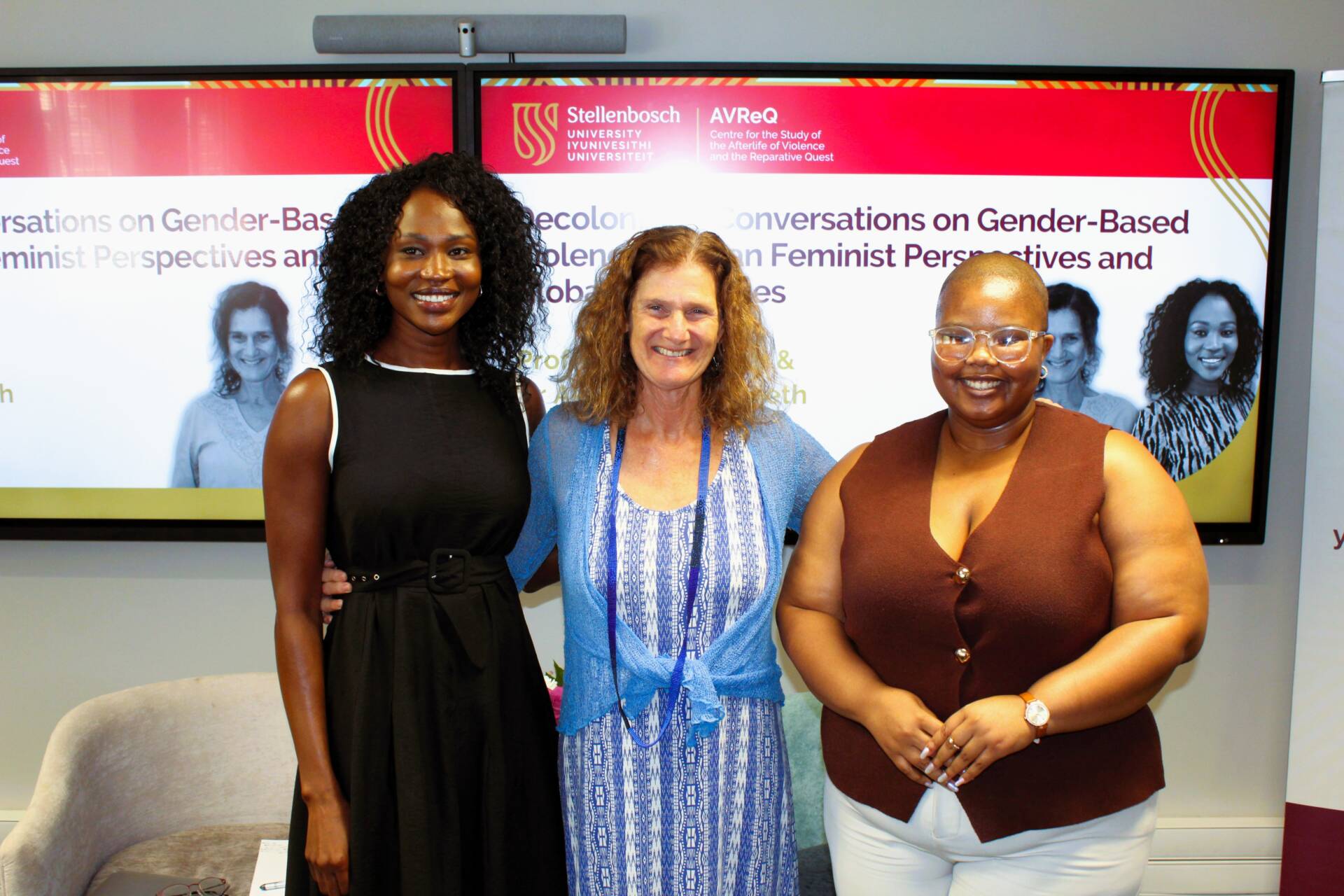
In opening the conversation, Professor Pumla Gobodo-Madikizela located the event within a longer history of struggle, solidarity and intellectual activism. Reflecting on her shared past with Professor Tamara Shefer as members of “psychologists against apartheid”, she recalled a generation of scholars who were “youngish”, politically committed and intent on challenging systems of violence. Her introduction emphasised that conversations on gender-based violence (GBV) are never isolated from other histories, and that the present moment demands the same critical engagement and collective courage. This framing set the tone for a discussion in which speakers grounded GBV within broader structures of inequality, power, colonial histories and contemporary global crises.
Moderator Zandile Dywati introduced the session by noting a persistent problem: the uneven and often contradictory ways in which GBV is defined, especially across policy, public discourse and academic research. Recalling a parliamentary exchange in which a minister argued that “a man slapping a woman is not violent, it’s just discipline”, she highlighted how everyday language can dilute the gravity of GBV, obscuring its structural and relational dimensions. Her opening question asked how both speakers conceptualise GBV in their own work, and how these definitions illuminate the ongoing tensions between global and African feminist frameworks.
Shefer situated her response within the early democratic period of the 1990s, when HIV intersected with emerging feminist research. Working with young women in poor communities, she observed that “everyday violences are endemic in young people’s relationships”, noting that coercive and violent sexual encounters were normalised in ways that profoundly shaped young women’s agency. What became increasingly clear to her was that GBV cannot be understood through “spectacular forms of violence” alone. Instead, GBV must be viewed as a product of intersecting social, historical and material inequalities.
Shefer argued that contemporary approaches to GBV frequently reproduce the very oppressions they seek to challenge. Because these approaches fail to apply a “critical, decolonial feminist lens”, they obscure the entanglements between colonial systems, patriarchal logics and global capitalist structures. Drawing on Sylvia Wynter, she reflected on how the dominant figure of “Man” as white, Western, heteronormative and male sets the standard of the human, rendering other bodies “dispensable” or “ungrievable”. For Shefer, GBV is therefore inseparable from the logics that shape global environmental destruction, militarised violence and differential valuing of human life.
Building on Shefer’s argument, Dr Akuch Kuol Anyieth located her entry into the field within the Australian context, where she worked extensively with migrant and refugee communities. She noted the political dynamics that determine “who is the ideal victim of GBV, or who is not”, especially for African, Indigenous and asylum-seeking women. Describing a case in which an African woman was “revictimised” through the legal system, she questioned why legal interventions that were intended to protect often resulted in punitive outcomes for whole families.
Her concern centred on the selective visibility of certain forms of violence. She cited examples of women in Sudan who “committed suicide rather than being raped” and the November abduction of 21 girls in Nigeria, pointing out that such events rarely reach global news agendas. This led her to ask “how is it that we pick and choose which bodies are newsworthy and which women bodies are not?” Her critique underscored how global politics of race, class and geography shape which victims receive attention and which are rendered invisible.
Zandile then turned the discussion toward the role of decolonial and intersectional feminist work in bearing witness to ongoing colonial legacies. In response, Anyieth reflected on the complexities of the term “decolonial”, noting that it is sometimes used as “a buzzword” in elite institutions. She proposed instead that decolonial feminist work must centre African and Indigenous knowledge systems, foregrounding how communities themselves conceptualise family, conflict and care. For her, meaningful decolonial approaches require co-creating knowledge and recognising that “they are not the limit” of Western theoretical frameworks.
Shefer echoed this sentiment, emphasising the need to reclaim and re-imagine gender beyond colonial binaries. While not romanticising precolonial societies, she highlighted examples of fluidity and diversity in gender and sexuality that have long been erased. Decolonial feminist work, in her view, demands attending to “slow violences” embedded in hunger, poverty and dispossession, as well as interrogating how global narratives construct the Global South as the perpetual problem while positioning the Global North as saviour.
The discussion then moved into questions of patriarchy, masculinity and the dangers of reproducing binaries. Anyieth suggested that “the idea of patriarchy in itself is very colonial”, emphasising the need to interrogate how power circulates within families across historical periods. Both speakers urged a rethinking of gendered norms, pointing out that cultural ideals such as the “wife material” trope or heteronormative expectations shape hierarchies in everyday life.
Throughout the session, participants raised questions about queer experiences of violence, hierarchical forms of harm within families and the need to move beyond disciplinary silos. Shefer advocated for drawing on artistic and creative forms to reshape social imagination, noting that “we can do a lot symbolically in making things like gender based violence unimaginable.”
In closing, Anyieth situated the event within the 16 Days of Activism and called for continued engagement beyond formal academic spaces. She reminded the audience of women in Sudan, Nigeria and Congo whose suffering remains unrecognised, and emphasised the ongoing need to challenge the gap between strong constitutional frameworks and their uneven implementation. Her final invitation captured the spirit of the dialogue: to keep thinking critically, collectively and transnationally about GBV, and to ensure that those rendered invisible remain central to feminist struggle.


