
Chifundo Kamba

Biography
PhD candidate specializing in the historical context of sexual violence and reparative justice in Malawi and British settler colonies (1891–1994). With over 14 years of tertiary teaching and extensive experience in NGO- and AU-supported field research, I possess strong skills in legal and policy analysis, mixed-methods research, project coordination, and stakeholder engagement. Committed to advancing justice for survivors through research-informed policy interventions.
Paper Title
Custom, Colonialism and Christianity: Conflicting Views on Rape and Sexual Consent in Twentienth Century Malawi, c. 1906-1929.
Abstract
This paper examines the contested understandings of rape and sexual consent in colonial Malawi between 1906 and 1929, highlighting the tensions between African customary law, Christian missionary ideologies, and colonial legal frameworks. While customary law often framed sexual relations within the context of marriage, prioritizing family and communal negotiations over individual consent, missionaries sought to impose a moral order that criminalized African sexual customs, equating them with immorality and moral degradation. Colonial administrators, in turn, selectively incorporated African perspectives into the legal system, using rape laws as a means of asserting control over African subjects. By analyzing court records, missionary writings, and colonial legal proceedings, this study reveals how conflicting legal and moral frameworks shaped the prosecution and adjudication of sexual violence. It argues that the colonial legal system neither fully protected African women from sexual violence nor upheld African customary approaches to justice, but rather served as a tool of racial and gendered power. The study contributes to broader debates on the intersections of gender, law, and colonial governance in African history.
Charlize Hermans

Biography
Charlize Hermans is a Master’s candidate in History at Stellenbosch University. She has a keen interest in exploring the complexities of South African history through ideological pathways such as political history, institutional history, and the histories of violence. Committed to rigorous research and critical analysis, she seeks to contribute to a more nuanced understanding of the country’s past and its implications for the present. Eager to engage with complex historical frameworks, she is dedicated to both scholarly inquiry and social relevance.
Paper Title
Towards a Post-Panopticon: The Ghostly Presences of Performed (and Policed) Calvinist Afrikaner Nationalism
Abstract
This paper explores how Calvinist Afrikaner nationalism was performed, policed, and institutionally enforced within the Faculty of Theology at Stellenbosch University between 1965 and 1989. Drawing on Michel Foucault’s Discipline and Punish, particularly the concept of the panopticon, the presentation examines how disciplinary power operated within an ideologically saturated academic environment. In this context, Calvinist nationalism functioned not only as a theological orientation but as a broader moral-political order that shaped the conduct of faculty, students, and institutional life.
Although this was a period marked by the overt presence of disciplinary mechanisms, the paper introduces the idea of a retrospective hauntology — informed by Jacques Derrida’s concept — to consider how the deeply embedded structures of Calvinist Afrikaner ideology have continued to echo within the institutional fabric, even after their formal decline. The notion of a “post-panopticon” is not deployed to suggest the end of disciplinary power during this period, but rather to reflect on how such power mutates over time: from visible institutional control to spectral residues that haunt the present.
By mapping moments of conformity, resistance, and anxiety within the Faculty, the presentation aims to show how power operated not only through top-down enforcement but also through embodied performance and the regulation of belief and behaviour. In doing so, it offers a framework for understanding the long afterlife of nationalist ideologies the Faculty — and how their traces persist in ways that are affective, spatial, and often invisible.
Irshaad Suliman
Biography
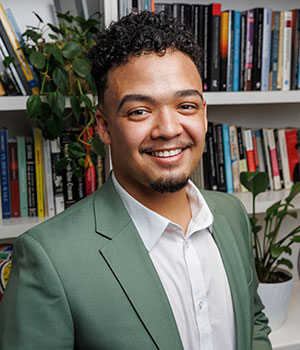
Mogammad Irshaad Suliman is a Research Fellow at AVReQ (The Centre for the Study of the Afterlife of Violence and the Reparative Quest) and a Master’s candidate in History at Stellenbosch University. He holds a Bachelor’s degree with majors in Anthropology, History, and Communication Studies from the University of the Free State, and completed his Honours degree in History at the University of the Western Cape. From 2022 to 2025, he worked as a Digitisation Assistant in the Audio-Visual section of the UWC-Robben Island Museum – Mayibuye Archives. In this role, he contributed to the preservation, documentation, and accessibility of South Africa’s cultural heritage, while also managing the archive’s social media presence to promote access to digital heritage materials.
Paper Title
Behind the Frontlines: Cape Muslim Anti-Apartheid Resistance to Everyday Struggles (1950-1996)
Abstract
This paper explores the underexamined role of Cape Muslim communities in resisting apartheid in South Africa between 1950 and 1996, focusing on how subjectivities were shaped and redefined through both overt and everyday (“small r”) acts of resistance. Moving beyond dominant historiographies that privilege formal political movements, militarized struggle, or iconic figures such as Imam Abdullah Haron, it adopts a decolonial and intersectional lens to foreground the contributions of lesser-known Muslim activists, teachers, religious leaders, women, and community organizers who navigated and contested apartheid’s spatial, social, and ideological violence.
Framed by the colloquium’s concern with the afterlives of violence and the enduring embodiment of trauma, this study examines how faith-based resistance was cultivated in homes, mosques, schools, and community kitchens. It situates Muslim resistance as a reparative response to apartheid’s racialized geographies and epistemic erasures, showing how Islamic ethics of justice, mercy, and solidarity became modes of survival, political agency, and alternative world-making.
Drawing on oral histories, archival records, and community narratives, the research traces how policies such as the Group Areas Act disrupted and reconfigured Muslim life in Cape Town. It examines how resistance emerged through acts of care, teaching, religious assertion, and neighbourhood solidarity, as seen in the work of figures like Shukoor Mowzer, Noorie Fakie, and Khalid Desai, and in grassroots initiatives like Qibla and Nakhlistan.
Ultimately, the paper contends that these everyday forms of resistance constitute a powerful archive of hope and ethical defiance, rooted in transgenerational community identity, that reframes Cape Muslim activism as central, rather than marginal, to the broader anti-apartheid struggle and to the shaping of post-violence identities in South Africa.
Cassidy Robinson
Biography
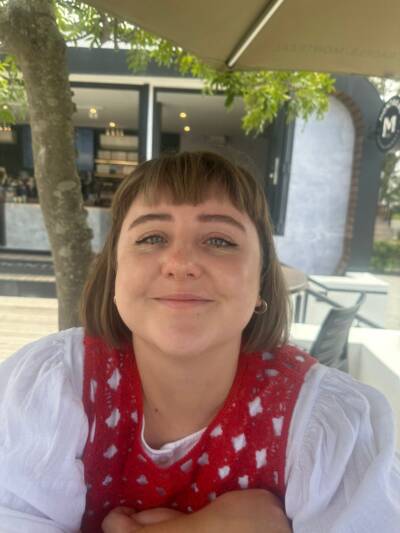
I am an MA Psychology student at Stellenbosch University. my supervisors are Prof Desmond Painter (psychology) and Prof Ernst van der Wal (Visual Arts). I am a listed ASCHP Specialist Wellness Counsellor and a Therapeutic Play Practitioner in training. I am passionate about the visual world and how art and art-making can provide alternative routes to not only healing, but understanding social phenomena. I have been privileged to lecture for the Visual Arts department on Art in Therapeutic contexts and would love to explore the topic of my thesis more, expanding to more populations or men, diversifying the sample groups and creating spaces where healing and art meet social transformation and education.
Paper Title
Re(Molding) Masculinity: Clay-Based Creative Conversations on Gender-Based Violence with Men at Stellenbosch University, South Africa
Abstract
Worldwide, gendered violence is an unrelenting force which colours every aspect of women’s lives. Too often, gendered violence is perceived and characterised solely as men’s violence against women despite research that provides alternative information. Within this widely held understanding of GBV, women are conceived of as only victims while men are always perpetrators, limiting and affecting one’s being in the world. This research investigates the lived experiences of male University Students at Stellenbosch within the context of gender-based violence and anti-GBV rhetoric in South Africa. It explored how a clay-focused, arts-based methodology can generate new and deeply affective social data. More specifically, the research focused on creatively collecting social data which speak to, and enhance an understanding of men’s experiences of anti-GBV movements, #MenAreTrash and their performance of masculinity. It simultaneously investigates the collaborators’ interaction with clay and artmaking as a means to ground sensitive topics and facilitate involvement and sharing within a group atmosphere. Using feminist participatory action research principles combined with an arts-based methodology, three 3.5-hour sessions of discussions, clay work and reflections were held over four weeks. Three collaborators participated in the study, all identifying as a man and enrolled at Stellenbosch University. The discussions were based on semi-structured interview schedules, which transformed from one session to the next and were analysed using thematic analysis. This was triangulated with the collaborators’ reflections on the art-making process, the meaning behind their creations as well as their written reflections thereof. Through this analysis, three major themes were uncovered; care, vulnerability and discomfort.
Jamio Verhoog
Biography
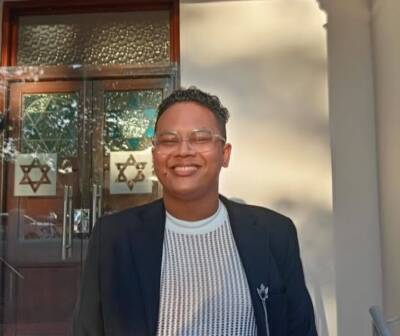
At 23 years old, Jamio Verhoog completed his Honour’s degree [cum laude] in General Linguistics with a particular focus on the sociolinguistic experiences of marginalised men in 2024. Jamio is currently in the first year of his Master’s program, where his research adopts an intersectional approach to language and masculinity. He is currently serving as a first-year Knowledge Skills tutor and a second-year teaching assistant for Applied English Studies. Jamio is one of the emerging male voices in South African sociolinguistics. A friend described that as “so far beyond” which is a fitting testament to the powerful voice he brings to his research.
Paper Title
Language and Masculinity Across Time and Space: An Investigation into the Lived Language Experiences of Coloured Men in the Cape Flats
Abstract
In Gender Based Violence discourses, conditions that shape men’s vulnerability and performance of gender in different and complex ways are often overlooked. Sociolinguistics has traditionally highlighted gender polarity that often disadvantages women. Feminist linguists raised awareness about women’s linguistic inequalities, improving the understanding of how language marginalizes women. So, less attention has been paid to how men, particularly men of colour, are positioned through language. Coloured men have been perpetually stereotyped with violence, gangsterism, alcoholism, rape, etc. However, this research explores how such stereotypes are linguistically and socially constructed. This study specifically examines how Afrikaaps functions both as a linguistic stereotype and an attempt to demonstrate how this language can be a marker to escalate or de-escalate situations. It also interrogates how the legacies of Apartheid continue to shape present day Coloured men’s masculinity in areas such as the Cape Flats. Using qualitative methods, including language portraits, semi-structured interviews and a focus group, this study explores Coloured men’s beliefs, attitudes, dispositions, ideas and experiences living in the Cape Flats and how they navigate the challenges within this area. This research draws on the lived experiences of ten Coloured men: five men who grew up during Apartheid and five men who grew up post-Apartheid. This study will shed light beyond the dominant narratives such as gangsterism, violence, alcohol abuse, etc. Coloured men are known for. By incorporating the concept complex personhood (Gordan, 1997), the study foregrounds the complexities, histories, experiences and social contexts of these men, which will allow for a deeper reflection and understanding how masculinity is negotiated in a community that is disenfranchised with restricted access to exemplar role models.
Carine Ndinga-Koumba-Binza
Biography
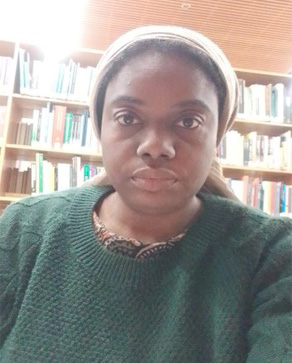
Estelle Carine NDINGA-KOUMBA-BINZA is an MA candidate in the Department of Foreign Languages at the University of the Western Cape. She holds a Bachelor degree and a Master degree in Business Marketing as well as a BA Honours in French. She is currently a Graduate Lecturing Assistant in the French section of the Department. Her research focuses on feminist rhetoric in the work of Marie NDiaye.
Paper Title
When Fiction Echoes Society’s Deflections: Victimisation of the Male Characters in Marie Ndiaye’s Three Strong Women
Abstract
The research question of the study contained in this paper can be read as follows: How does society view gender-based violence suffered by men? The study analyses Marie Ndiaye’s novel, Three Strong Women, as a reflection of a geographically mixed society between Africa and Europe. It is well known that characters in fictional literary works are not created ex nihilo. Authors bring their characters to life through physical, moral, and even psychological traits, often on the basis of realistic social issues, events, or lived experiences. The study adopts the methodological framework of textual analysis and grounded theory within the historical-cultural theoretical approach of the psyche. This helps to demonstrate that the authoritarian and petty excesses of men towards those around them would be the result of the traumas of which they had been victims. In other words, just like the heroines of the novel, the male characters are also prey to certain decadences in their social environments. The paper contains two sections. Section 1 deals with issues about society, social status, family structures, and their influence on the choices or decisions of individuals. Section 2 highlights and interprets the male characters’ behavioural causes and effects by observing interactions within their familiar circles. This study contributes to a plea for more inclusive policies and awareness campaigns against gender-based violence.
Mohhadiah Rafique
Biography
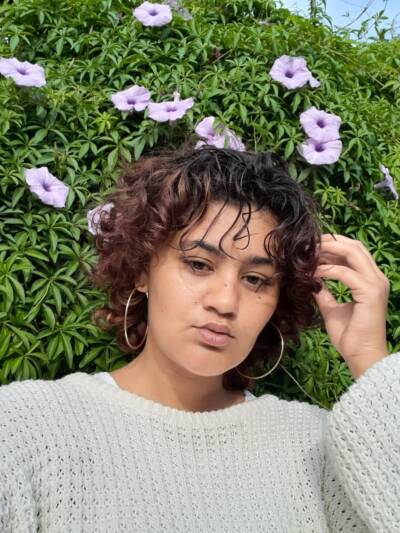
Mohhadiah Rafique is a PhD Candidate in Psychiatry at Stellenbosch University (SU). She holds a Master’s degree in Research Psychology, Bachelor of Arts Honours degree in Psychology (Cum Laude) and Bachelor of Science degree in Human Life Sciences with Psychology, from SU. Currently, she is a South NRF-funded doctoral fellow at the Centre for the Study of the Afterlife of Violence and the Reparative Quest under the SARChi Chair in Violent Histories and Transgenerational Trauma. She has presented her mental health and neuroethics research at national and international conferences. Her research interests lie in the mental health of marginalized communities, working towards the decolonial project, and incorporating arts-based methods for eliciting data. She has also first and co-authored publications in mental health and neuroethics.
Paper Title
Exploring the Meaning-Making of Schizophrenia Amongst Coloured Communities in Cape Town, South Africa
Abstract
During apartheid, South-Africans were classified into four hierarchical racial categories; white, Indian, Coloured, and Black. However, the term Coloured has been redefined and reclaimed by many Coloured people as a cultural and ethnic identity. Despite the dawn of democracy, legacies of colonialism and apartheid left generations of South-Africans with a range of psychosocial issues. Manifestations of transgenerational trauma like structural racism and neighbourhood disadvantages have mental health implications. Racial disparities are sustained in public healthcare, while neighbourhood disadvantages pose risk factors contributing to the onset and relapse of schizophrenia. Thus, historical and sociopolitical factors have shaped the lived experiences and meaning making of schizophrenia. Given the identity politics of Coloured Identity, the nexus of meaning-making becomes more complex. Further highlighting the need to gain a deeper understanding of these nuanced experiences, ensuring that we endorse a mental healthcare system that caters to contextual and cultural needs of diverse people. The proposed study aims to explore how South African Coloured people living with schizophrenia and their family members co-create meaning and understanding of their condition and their response to its recurrence. Moreso, it aims to explore how these understandings are shaped by family history, sociopolitical conditions, spiritual and cultural beliefs, and experiences of marginalization. The study will comprise a series of semi-structured interviews, photovoice, and relational mapping. Data will be analysed using narrative and thematic analysis. The study’s contribution to the mental health field is the reconceptualization of how we view schizophrenia amongst marginalized identities while promoting destigmatization.
Leza Soldaat
Biography
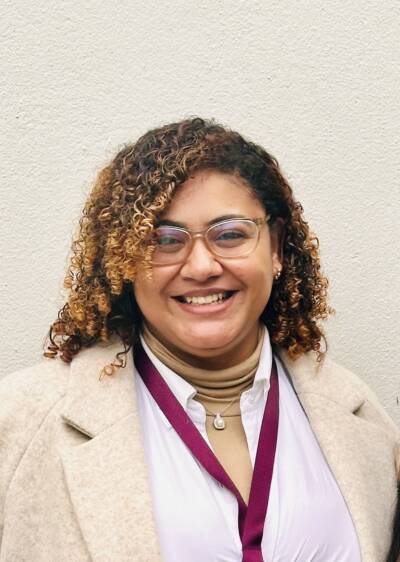
Leza Soldaat is a Research Supervisor at Boston City Campus and a PhD Candidate in Sociology at Stellenbosch University. She is an educationalist, a feminist, and a published scholar. One of her publications include “Challenging the deficit discourse: Insight from university staff about first generation students in South Africa and the United Kingdom” published in Knowledge beyond the colour lines: Towards repurposing knowledge generation, knowledge sharing and critical pedagogy in Higher Education in South Africa and beyond.
Paper Title
Beyond Apartheid’s Categorisation: Reimagining Coloured Belonging Today
Abstract
My doctoral study titled Exploring Coloured Identity: An analysis of power dynamics, language politics, and cultural resistance focuses on a postcolonial formation shaped by the violence of racial categorisation, spatial displacement, and cultural erasure. This identity, shaped by historical and contemporary social, political, and cultural forces, presents a unique case study to explore how the spatial legacies of apartheid continue to manifest as continuities of racialisation, embedding past traumas within contemporary lived experiences and perpetuating social and economic disparities. The proposed presentation will explore how historical trauma is embodied and inherited, yet also how healing can emerge through re-narration and community-based meaning-making. This reframing is crucial for dismantling the enduring psychic and social scars of colonialism and apartheid. I recognise the challenges of navigating these levels of analysis without oversimplifying the complexities involved. I, therefore, emphasize context and contextualising. This allows me to navigate the complexities while avoiding oversimplifying and ethnocentrism. My preliminary findings show the multifaceted cultural expressions within the Coloured community, that is often overlooked, or written in the negative (i.e., misery research). Moving beyond pathologizing constructions of Coloured subjectivity as inherently fragmented, this abstract advocates for a humanising and healing approach. By acknowledging the historical pain while simultaneously celebrating the richness and complexity of Coloured identities, the aim of my research, and in turn the proposed presentation, is to foster spaces for healing and reconstruct narratives that affirm belonging and dignity. In doing so, it contributes to a broader project of decolonising knowledge by recognising the ways in which Coloured identity reflects entangled histories, contested belonging, and the potential for collective healing.
Zanele Mqukumba
Biography
coming soon.
Paper Title
Carrying the Unspoken: The Body as an Archive of Generational Trauma in Social Work Praxis
Abstract
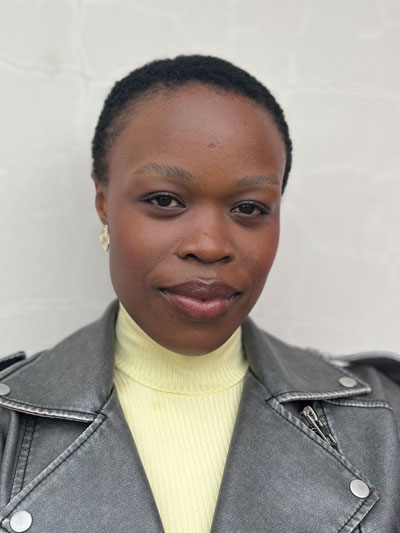
This paper explores the body as a site of rupture, memory, and resistance within the context of transgenerational trauma in the Global South, particularly through the lens of social work and lived experience. Drawing from my academic and personal journey as a young Black woman navigating post-apartheid South Africa, I reflect on how trauma—especially inherited trauma—manifests somatically, shaping how individuals engage with care work, education, and community life.
Inspired by Bessel van der Kolk’s The Body Keeps the Score and Oprah Winfrey and Dr. Bruce Perry’s What Happened to You? I consider how trauma is embedded in the nervous system, often showing up in the body before it is consciously understood. These texts affirm what I have observed through fieldwork and reflection: the body holds histories that words sometimes cannot reach. As a social worker engaging with communities facing food insecurity, poverty, and displacement, I have come to recognize how trauma lives on in everyday routines, emotional reactivity, and even body language.
I also reflect on my own body as an archive—a place where personal and generational trauma converge. Within social work, the practitioner is often assumed to be the “helper,” yet we too are shaped by the unresolved pain of our lineages. What Happened to You? invites us to shift from asking “What’s wrong with you?” to “What happened to you?”—a framework I bring to both academic inquiry and practice.
This paper calls for a deeper understanding of how bodies in the Global South carry colonial and structural wounds. It argues for embodied, relational approaches to healing that move beyond pathologizing and toward practices of witnessing, tenderness, and reparation.
Fhatuwani Muswobi
Biography
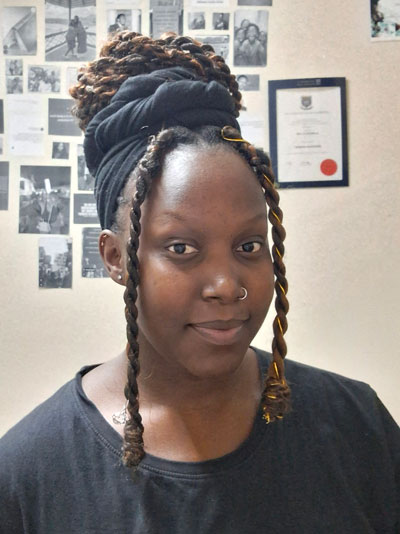
Fhatuwani Muswobi is a student at the University of the Western Cape who is currently pursuing her masters in Comparative Constitutional Law. She is a scholar with an interest in decolonial studies and is passionate about Black consciousness. She dreams of making an impact on as many people’s lives as she can in her lifetime.
Paper Title
Violence and Anti-Blackness in ‘Post’-Colonial Times
Abstract
Eurocentrism teaches us that the past is the past and has already happened and has nothing to do with present day positionalities. Society further teaches us that our past happened a long time ago, negating the parts where the past produces and reproduces itself because it continuously goes unchecked. As Pumla Gqola teaches us that the violent history surrounding Africa from the point of colonial contact is one filled with shame, unfortunately that shame is carried by those who are either Black or anything other than white. This shame is further perpetuated by a fear of this violent past, because the retelling of history almost displays a disjuncture between violence and the present. This way of telling history unfortunately not only erases Black pain in the past but furthers this erasure into the present because the linear telling of history does not allow for the co-existence of the past and present neither does it acknowledge either the inherited pain and present injustices that are a product of colonialism and/or coloniality. This Black erasure is treated by some historians as almost a mistake of colonialism, but this paper intends to assert and prove that as argued by mills this constant Black erasure was and/or is a facet of colonialism/colonisation. This paper will thus critique modernity and argue that it is a product of eurocentrism and further rationalises and normalises Anti-blackness thus the constant negation of Black bodies even in the present society. The aim of this paper is to show that the past keeps reproducing itself and that the violence also mutates overtime but is still received by the same demographic. This paper will be guided by decolonial theory, Azanian political thought and will use a PAN Africanism approach to further the arguments made.
Beth Caygill
Biography
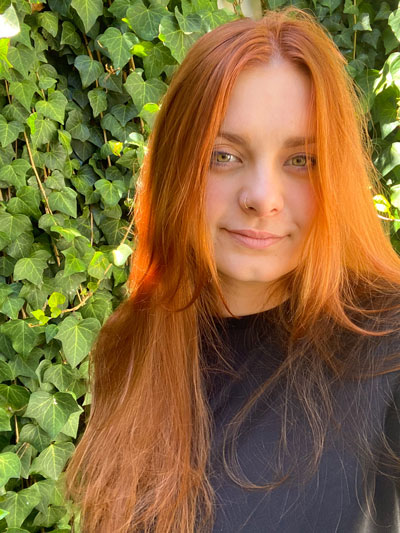
I’m Beth Caygill (she/her), a Master’s student in Gender & Transformation at the University of Cape Town. After finishing my BA in English, History & Classical Studies and a Honours in Historical Studies at UCT, I turned towards education and teaching, completing my PGCE. However, gender-based violence in South Africa is a topic very close to my heart and I could not stay away for long. Throughout my Masters, I have brought my attention to gender-based violence and how early-career researchers handle the vicarious trauma and resilience it brings. This project is incredibly close to me. And as such I weave my own voice through auto-ethnography into it along with narrative inquiry in order to map both harm and resilience. Outside of university, I have worked with organisations like Asikihulumeni, bringing conversations about gender-based violence into the classroom. I also teach English and tutor History.
Paper Title
Learning to Hold Grief and Gratitude: The Life Experiences of Early Career Feminist Trauma Researchers Researching Gender-based Violence in South Africa.
Abstract
coming soon.
Silulundi Coki
Biography
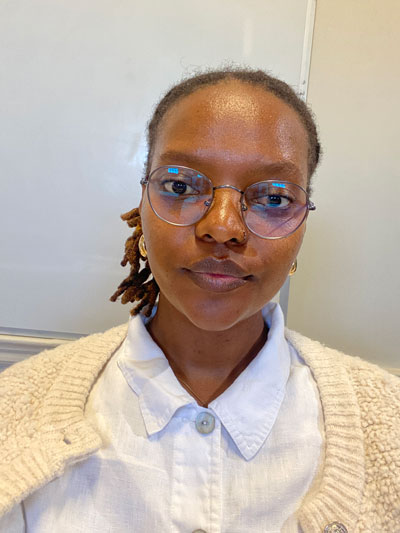
Silulundi Coki is a master’s candidate at the University of Cape Town, specializing in African Languages and Literature. Her research focuses on language used in normalisation or acceptance of Gender-based Violence in Male selected isiXhosa literature: an African feminist Approach.
She holds a Bachelor of Arts (awarded on the Dean’s Merit List) and a BA Honours in African Languages and Literature (Cum Laude) both from UCT. Silulundi has received several accolades, including the UCT Plus Silver Award (2024) and Gold Award (2023) for her peer leadership and mentoring contributions in the Humanities Undergraduate Mentoring Programme and UCT Mandisa programme. She is also a recipient of the Harry Crossley Scholarship.
Paper Title
An Investigation on the Language Used in the Normalisation or Acceptance of Gender-Based Violence in Male-Selected Isixhosa Literature: An African Feminisms Approach
Abstract
The conditions of Black South African women have been the object of intense discussion because the culture is strongly patriarchal and conservative (Gumede, 2018). This study seeks to investigate how Gender-Based Violence against South African women is portrayed in South African isiXhosa Literature. Gender-based violence (GBV) refers to all forms of violence against women, including psychological abuse, cultural practices such as forced marriages, physical violence, and sexual violence (Tamwa, 2013). I have selected two distinct eras of isiXhosa novels; these timeframes will be representing the lives of traditional women in rural communities and the lives of modern women. Selected novels are as follows: Iingceba Zegazi S. Nolutshungu (2011), and Ingqumbo Yeminyanya (the wrath of ancestors) AC Jordan (1965). This is a qualitative study in nature and employs a thematic approach, critical discourse and reflection theory to analyse the social ills against women and children which is mirrored in the isiXhosa literary writings.
The study is framed within African Feminisms, to examine the culture and traditional norms within African context that led to the oppression of women and their resistance to the Gender-based violence. This framework considers the interplay between gender-based violence, race, class, language and cultural background. The study’s emphasis on South African isiXhosa novels fills a significant gap in the existing literature landscape, offering crucial insights into gender-based violence within a specific linguistic, language and cultural context. Through observing the language used in normalising or accepting the depiction of women around the narrative of gender-based violence in the selected isiXhosa literary works, the findings show narratives of the family as a source of inequality and sexual violence, women as secondary victims and the invisibilisation of women.
Lynne Goldschmidt
Biography
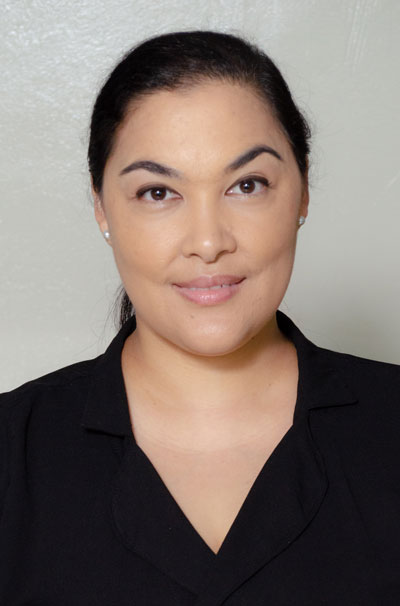
Lynne Goldschmidt is a registered Counselling Psychologist who currently works in private practice while collaborating with community-based initiatives. Her work is grounded in Decolonial and African-centred frameworks, with a particular focus on systemic and structural violence in the South African context. She has a strong interest in critical community interventions and in exploring the intergenerational transmission of trauma and its broader implications. She holds an MA in Social and Public Policy, an MA in Community-Based Counselling Psychology, and has recently completed her PhD in Psychology.
Paper Title
The Recurring Systemic Intersectional Inheritance of Gender, Sexuality and Violence.
Abstract
Violence may be regarded as a systemic inheritance across any landscape subject to human experience. Women are nonetheless increasingly vulnerable to violence given the biased social and political constructions and power imbalances associated with gender, sex and sexuality. Whilst this assertion holds relevance across most societies, it is of particular concern in societies subject to conflict and human rights violations. The South African context mirrors this concern, with gendered subjugation central across its political epochs, including the present day. Reflecting on memories shared and remembered by women descendants of women anti-apartheid activists, this research engages with women activists’ vulnerability to subjugation amid their resistance. The accounts shared demonstrate the extent to which racialised-gendered violations are inescapably woven into each account, with no memory untouched by their imprint. Drawing on cylindrical epiphenomenal temporality, the descendant testimonies echo the systemic intergenerational inheritance of violence and trauma. Drawing on African-centred epistemologies and decolonial feminist frameworks, memory functions not simply as recollection, but as a site of resistance. The descendant narratives demonstrate how intersectional categories are deeply informed by contextual and historical milieus. This entanglement demonstrates the way the past remains alive in the present. This includes the systemic intergenerational inheritance of sustained systemic and structural violences that have informed their lived experience. Descendants are thereby the bearers of their own trauma, whilst simultaneously tasked to survive the trauma borne by their forebearers. In this sense, revealing the repetition of violence across descendant accounts becomes more than an archival domain of the colonial wound; it presents a disruption of silencing and a refusal to render such violence invisible.
Li’Tsoanelo Zwane

Biography
Li’Tsoanelo Zwane hails from Gugulethu, Cape Town. Her educational background includes a Bachelor of Education (Cum Laude) degree from the University of the Western Cape, Bachelor of Education (Hons) and a Master of Philosophy degree (Cum Laude in the dissertation) both from the University of Cape Town. She is currently pursuing Doctoral studies at the University of the Western Cape within the Religion and Theology department. Her research interests include African Initiated Churches, African Metaphysics which includes the work of traditional healers and indigenous knowledge systems, decoloniality and The Divine Mother (feminine expression of God). She is a decade-long practising Sangoma and Gobela. She is a Section 11 advisory board member of the South African Human Rights Commission, she is a member of the Traditional Healers Organization and a member of the Association of the Study of Religions in Southern Africa.
Paper Title
Ingqumbo Yeminyanya. Genealogical Rage as a Destructive/Constructive Vessel for Reparations.
Abstract
Rage is often portrayed as an undesirable and destructive emotion. Our mothers, grandmothers and great-grandmothers were forced to swallow their anger to keep the peace. South Africa has a culture of silencing the wronged and dismissing our rage as inappropriate responses to injustice and oppression. We have seen this through the national demand for feminine ‘resilience’ in the face of violence captured in you strike a woman, you strike a rock. Women are expected to endure the violence against us through imposed constructs of ‘strength’ and ‘perseverance’. Our humanity and our right to have emotional responses to the atrocities committed against us is contested- we are reduced to being ‘rocks’(unfeeling inanimate objects) and our value becomes about how much abuse we can take rather than substantively addressing what normalises abuse against us. The force-feeding of reconciliation through the disastrous Truth and Reconciliation Commission, the rush to embrace Mandela’s rainbow nationism, the white-washing of Ubuntu and the crusading of forgiveness as a post-Apartheid ‘nation-building’ exercise all point to a deeply entrenched macrocosmic culture where victims are burdened with unfair moral expectations which not only impede legitimate accountability mechanisms, but the rightful rage of the oppressed is dismissed for the comfort of perpetrators. Because of this, our rage is held hostage and our bodies carry intergenerational ancestral anger, ingqumbo yeminyanya, which we have inherited from our grandmothers. This genealogical rage demands acknowledgement and reparative justice. By cutting through false pleasantries, rage can be transformative and provide pathways for reparative and restorative gender justice. I propose leaning into rage as a destructive and constructive supernatural force hostile to superfluous illusions of reconciliation, social harmony and placating the anxieties of perpetrators
Azania Tyhali
Biography
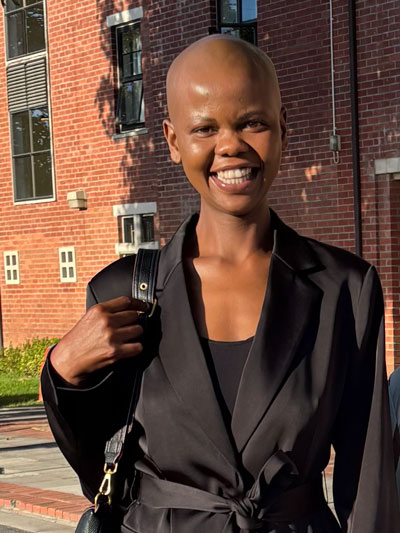
I am a graduate from the University of the Western Cape, currently pursuing my master’s degree at UWC. My work focuses on migration and mobility within blackness and decolonization, linking mobility with freedom and viewing migration structurally as a consequence of colonialism and imperialism. Theory and praxis are inseparable; I have participated in movements such as Fees Must Fall and workers’ struggles at UWC. I am former UWC president and active in civil organizations like the Black National Crisis Committee. Currently, I am spokesperson of the Pan Africanist Congress of Azania. I engage feminist politics through the lens of race, class, and gender, especially regarding poor black women. I was nominated for a student leadership award in 2018/2019 and serve on the board of the Black Peoples National Crisis Committee
Paper Title
On Becoming a Subject: Gendered Violence, Accommodation, And the Crisis of Being in Historically Black Institutions.
Abstract
This paper explores subjectivity through the naked protests at universities in 2016 during the ‘Fees Must Fall’ movement. This was central to addressing the coloniality of gender and patriarchy in South African institutions. Within Afro-pessimism and decoloniality, the paper argues gender is not just biologically determined but a conscious tool of subjectivity creating sub-ontological categories. Rooted in capitalist patriarchy of white supremacy, these have merged into the new coloniality. The text explores how these categories are perpetuated through higher education spaces in South Africa and shape subjectivity. The study focuses on a historically black institution, using the accommodation crisis to unpack these dynamics through Jared Sexton’s concept of ‘borrowed institutionality.’ I approach the inquiry from the perspective of higher education’s evolution from historically white to black universities, which reproduce objectivities. Rather than a purely historical view, I locate this from South Africa’s settler colony origins, showing how black institutions construct gendered subjectivities under coloniality. Structural problems like the accommodation crisis become institutionalized violence. Tropes about women in hostels and sugar daddy culture are examined: Where do these images come from? What ideas enable gendered violence? Using myself as a subject, I read the space as one of unspoken violence where institutions cannot imagine how “the crisis illuminates this endless war between absence and disclosure” (Marriot, 2024). The crisis of accommodation and gender violence in higher education does not create chaos but reveals the war between absence and disclosure. This paper proposes rethinking gendered categories in educational institutions possessed by gender and do not possess gender.
Florenzo Mapu

Biography
Florenzo Mapu is an MA candidate in Psychological Research at the University of Cape Town. He has a background in research on topics spanning PTSD, maladaptive neuroplasticity in addiction, personality, and psychological resilience in single motherhood. Florenzo holds both a Bachelor of Arts degree in English Literature and Psychology (Cum Laude) and a BA Honours in Psychology specialising in Development Psychology (Cum Laude), where he was trained in integrating the biological, psychological, and social aspects of development. His current research interests explore racial identity development and the cultural and societal messaging that leads to its formation in the post-apartheid South Africa (especially where historically marginalised peoples are concerned). Having utilised the autoethnographic approach to explore his own discomfort with colonial and patriarchal influences on racial identity formation, Florenzo has since looked at integrating critical qualitative approaches to further inform his research endeavours that surround exploring different facets of the human experience and expectations from a society that is still permeated by patriarchal and Eurocentric discourses.
Paper Title
Exploring Coloured Identity and Self-concept in Post apartheid South Africa: An Autoethnographic Answer to the Coloured Stereotype
Abstract
My experiences with race and its place in society and history has had a profound influence on the meaning I derive from my racial identity. The problematic stereotyping of the Coloured community has contributed to the internalisation of conflicting feelings about my racial identity. This study explores the development of racial identity through the lens of a Coloured born free man in post-apartheid South Africa. A gap in the literature on Coloured identity amongst born-free South Africans has inspired an autoethnographic approach using the Critical Race Theory and the Racial Development Theory to make sense of my experiences in the broader scheme of the sociopolitical and historical aspects of South Africa.
Lauren Grootboom
Biography
Lauren Marsha Grootboom is a PhD candidate in Civil Engineering at the University of Cape Town, where her research integrates Indigenous Knowledge Systems into water resilience strategies in peri-urban and rural South African communities. With a background in Justice and Transformation, Gender Studies, and African Feminist scholarship, her work bridges technical research with decolonial storytelling and social justice. Lauren’s creative research practice includes ethnographic fieldwork, digital archiving, and arts-based dissemination, with a focus on Black women’s lived experiences and intergenerational trauma.
Paper Title
1. The Transgenerational Transfer of Violence: How Apartheid’s Racial Classification Shaped Black Women’s Subjectivities Across Generations
2. Echoes of Her Silence: Black Women’s Memory and Resistance Across Generations
Abstract
- Whilst scholarship has examined apartheid’s immediate impacts, limited research explores how this violence transfers across generations, particularly through Black women’s lived experiences of being classified as “Coloured” during the 1950s-1960s under apartheid’s racial classification. This study addresses gaps in understanding transgenerational trauma transmission in post-apartheid South Africa. By centring Black women’s subjectivities across three generations, it examines how apartheid’s violent instruments continue to shape contemporary identity formations, challenging linear narratives of post-apartheid “transition.” Employing African feminist oral history methodology, semi-structured interviews were conducted with first, second, and third-generation descendants of Black women racially reclassified in Graaff-Reinet and Cape Town. Participants were selected through purposive and snowball sampling from historically Black and Coloured townships in both rural and urban contexts. Findings reveal distinct patterns of violence transmission across generations. First-generation participants experienced direct classification violence and forced removals. Second and third-generation descendants inherited fragmented cultural identities, linguistic alienation, and disrupted spatial belonging. Violence transfers through silence, memory gaps, and inherited marginalisation, yet also through protective strategies of communal care, spirituality, and resistance. This research demonstrates how apartheid’s violence embeds itself transgenerationally in Black women’s subjectivities, revealing the ongoing afterlives of historical trauma. The study contributes to understanding how colonial and apartheid violence continues to structure contemporary experiences in post-apartheid South Africa.
- Traditional academic dissemination often fails to capture the embodied nature of transgenerational trauma and the nuanced ways Black women navigate post-violence subjectivities. Arts-based research offers alternative pathways for representing lived experiences that resist colonial knowledge production, especially when examining apartheid’s racial classification legacy. This project responds to the need for decolonised dissemination by honouring Black women’s storytelling traditions. Through transforming oral history interviews into visual narrative, the short film makes visible the embodied transmission of trauma while challenging academic gatekeeping that excludes community voices. Drawing from African feminist filmmaking, the film weaves narratives from three generations of Black women in Graaff-Reinet and Cape Town. Using participants’ voices, archival imagery, and symbolic visual metaphors, it explores memory and trauma through a multi-sensory lens. Three critical dimensions anchor the film: (1) Gendered experiences of imposed racial identities; (2) Silence as a coping strategy—reframed as protection and resistance; (3) Intergenerational knowledge transfer through cultural practices, language, and embodied wisdom.
- This creative methodology decolonises academic knowledge while making transgenerational trauma visible beyond scholarly boundaries. The film serves as both research dissemination and community archive, honouring Black women’s resilience and revealing apartheid’s enduring impact on contemporary South African subjectivities
Reshoketswe Mapokgole
Biography
Reshoketswe Mapokgole is a South African feminist educator and activist with over a decade of experience in curriculum design and activist training. They hold degrees from Trinity College (BA Hons) and the University of Pretoria (MPhil in Human Rights Law and Democratisation in Africa), and are currently pursuing a PhD in Social Anthropology exploring Black mothering in South Africa. Reshoketswe specialises in pedagogical and movement-building work where they partner with social movements and human rights organisations across Southern and East Africa.
Paper Title
Exploring Batlokwa Women’s Experiences of Mothering in an Anti-Black Context
Abstract
This presentation will discuss the research proposal for my PhD project, which focuses on mothering in an anti-Black context in rural South Africa. Mothers are everywhere. Many of us have been mothered, know mothers and have even encountered the invented mother in media and folklore; motherhood is then so familiar that it is assumed to be known, to the extent that its significance has been obscured. In South Africa, this obscuring of mothers’ voices becomes more pronounced through racial and class exclusion, where the lives and experiences of rural Black women have been pushed to the margins. Thus, despite South Africa’s realities of anti-Black racism there remains limited scholarship that examines how Black mothers experience and practice mothering under such conditions. While this research is growing in the United States and Brazil, studies in South Africa have rarely explored how racism informs maternal practices and identities. This research addresses the gap by focusing on Batlokwa mothers in Limpopo. The research asks: How do Batlokwa mothers practice mothering in the context of anti-Black racism and what thinking informs and emerges through their mothering practices? How do the Batlokwa culture and indigenous knowledge inform these practices? And lastly, how do experiences of anti-Black racism impact these practices?
Lesedi Mashego
Biography
Lesedi Itumeleng Mashego is a research fellow at AVReQ pursuing an MA in Psychology (thesis) at Stellenbosch University. She holds a BSc in Human Life Sciences and a BA Honours in Psychology (cum laude). Passionate about African literature, she collects books in her spare time, with Chimamanda Ngozi Adichie as her favourite author. Her research explores how Black women construct their feminine identities within the context of mother–daughter relationships, with a particular focus on the meanings ascribed to strength and womanhood. Centring narratives emerging from the mother–daughter relationship, her work examines how daughters engage with, resist, and reinterpret dominant constructions of Black femininity, especially the Strong Black Woman trope, transmitted across generations. She interrogates how the expectation for Black women to endure and persevere, shapes identity formation. Her research highlights the role of maternal influence, as well as spaces of agency and resistance, in shaping and transmitting Black feminine identity in contemporary South Africa.
Paper Title
Beyond the Rock: Negotiating Black Feminine Identity and Strength Across Generations
Abstract
This presentation explores the intergenerational transmission of black feminine identity and strength within South African mother–daughter relationships, interrogating how these narratives are constructed, embodied, and resisted in contemporary contexts shaped by enduring socio-historical violence. Situated within a decolonial feminist and intersectional framework, it examines how dominant constructions of black femininity, rooted in colonial, apartheid, and patriarchal ideologies, are reproduced or contested across generations. The reviewed literature highlights that prevailing ideals of “respectable” black womanhood often emphasise acquiescent femininity, encompassing modesty, sexual purity, domesticity, and self-sacrifice, and the “Strong Black Woman” trope, which demands resilience, endurance, and emotional fortitude in the face of oppression. These ideals, transmitted through maternal narratives and practices, both constrain and empower daughters’ self-definition.
By foregrounding the mother-daughter relationship as a site of knowledge production, the presentation considers how mothers lived experiences, shaped by intersecting oppressions of race, gender, and class, influence daughters’ understandings of strength and womanhood. Additionally, the presentation seeks to capture how daughters negotiate tensions between inherited ideals and their own evolving identities, revealing both continuities and ruptures in the meanings attached to black femininity. Engaging the colloquium’s theme of ‘Post’-Violence Subjectivities in the Global South, this work interrogates how historical violences persist in gendered identity constructions, particularly through the valorisation of endurance and the silencing of vulnerability. It contributes to broader discussions on transgenerational trauma by illuminating the affective and discursive legacies that shape subjectivity, memory, and relationality in Black South African women’s lives. Ultimately, the study aims to move beyond pathologising narratives, centering women’s voices to imagine humanising and reparative ways of relating to these inherited legacies.
Gemma Paton
Biography
Gemma Paton (they/them) completed their Honours degree with a distinction at the University of Cape Town in 2024, and is currently working on their Masters degree in Gender and Transformation with the African Feminist Studies department. Their research utilises queer African feminist theory to explore the complex relationship between queerness and whiteness, with the aim of imagining how ‘queering’ might serve as a tool to deconstruct the destructive, normative operations of whiteness in everyday life. Their Honours research as an initial step toward reimagining whiteness—using queering to resist, subvert, and disrupt its normative functioning on a daily basis.
Paper Title
‘Post’-Violence Subjectivities and the Body: Racialised Queer Embodiment and Accountability in the Global South
Abstract
This research critically explores queer and white embodiment through a queer African feminist methodology to highlight the urgent need for accountability in contemporary contexts of privilege and marginalisation. Utilizing a mixed-methods approach combining qualitative interviews and photovoice, the research reveals that whiteness produces a privileged queer experience that functions as an invisible, largely unexamined bodily norm. The participant collaborators readily articulated queerness as a bodily experience, yet struggled to connect whiteness to a bodily experience, emphasizing the body as a contested space where power, privilege, and history are inscribed. This invisibility reflects how colonial legacies persist not only in social structures but also in spatial and bodily realities, underscoring that racialised queer embodiment is inseparable from spatial and historical contexts shaped by structural violence.
Crucially, addressing structural violence cannot rest solely on the perspectives of those who experience discrimination. Focusing exclusively on the marginalized risks leaving privilege unexamined and unquestioned by those who embody it. Therefore, this study calls for a critical engagement with both privileged and marginal identities to foster accountability and disrupt continuing violences—spatial, racial, and embodied. By situating embodiment within intersecting registers of race, space, and affect rooted in colonial histories, this research offers vital insights into the complexities of identity embodiment. It provides a foundation for further inquiry into how accountability can be enacted through embodied praxis that challenges normative whiteness and spatial racialisation, thus relevant to discourse on ‘Post’-Violence Subjectivities in the Global South, where the afterlives of violence continue to shape bodies, spaces, and identities.
Jesse Le Roux
Biography
Jesse Baronne Le Roux is a master’s candidate in History at Stellenbosch University, with a BA (Hons) in History (Cum Laude). As a research fellow at AVReQ, his focus lies in exploring history, identity, and sexuality, particularly within marginalized groups. Jesse’s passion for understanding and amplifying voices often silenced by mainstream narratives drives his research. He aims to foster inclusive dialogues and challenge existing frameworks, using history as a tool for social change.
Paper Title
Queer Memory and Affect: Navigating Belonging in QueerUS at Stellenbosch University
Abstract
Stellenbosch University (SU) has long been seen as a conservative institution, but it has also witnessed important moments of resistance to dominant social norms. In the late 1980s and 1990s, student activism connected to broader movements like the Voëlvry Movement helped open space for queer student societies on campus. My research traces the history of institutionalized queerness at SU through its LGBTQ+ society, founded as Les-Be-Gay in 1999 and evolving into QueerUS in 2018.
This paper focuses on the QueerUS era, looking at how queer students navigate belonging and alienation both within the society itself and across the wider campus context. While direct accounts of trauma and violence are more visible in the earlier Les-Be-Gay/Lesbigay period, this study highlights how ongoing legacies of exclusion, marginalization, and structural violence continue to shape queer subjectivities in more subtle but no less powerful ways. Drawing on interview data alongside queer memory work and affect theory, I argue that QueerUS operates as a crucial site for community-building and resistance, where students can articulate and negotiate their identities and sense of belonging despite persistent social challenges.
Benita Petersen

Biography
I am an Associate Lecturer at the University of the Western Cape, where I am also a PhD Candidate.
Paper Title
coming soon.
Abstract
This research explores the intersections in the governance of land, identity, housing, and labour in the semi-rural Western Cape towns of Grabouw, Genadendal, and Villiersdorp in the context of the persistent legacies of racial capitalism. My interest is on the local state, inequalities, power and the politics of belonging.
The research will explore the thesis that colonial land dispossession, exploitative farm labour systems, and systemic housing exclusion have not been dismantled in democratic South Africa but have instead mutated into bureaucratic and market-driven forms of marginalisation linked to new forms of labour stratification.
Drawing on racial capitalism theory, critical public administration, and using mainly qualitative fieldwork, the study investigates how municipalities, farmers, and local subordinate groups interact within a governance framework that promises inclusion but delivers conditional access and disposability. The research contributes to rethinking housing and identity debates outside of major urban areas in South Africa.
Owam Stamper
Biography
Owam Stamper is currently a master’s student specializing in Theories of Justice and Inequality within the Sociology department at the University of Cape Town. Her research focusses of race, space, gender and identity. Her honours research focussed on women within the Cape Town taxi industry and her master’s research which she is working on focusses on the politics of space in Langa hostels 30 years after democracy.
Paper Title
Spatial Politics in Hostels in a Post-Apartheid South Africa
Abstract
This paper explores migrant labour hostels through the politics of space and racial capitalism in post-apartheid South Africa. Migrant labour hostels in South Africa were fundamental for industrialisation and capitalist agenda of the apartheid regime. These migrant labour hostels housed Black men from rural areas into urban areas only for the purpose of their labour. These hostels created certain forms of masculinities and destroyed Black families over time. Although they have now been renamed, they still exist and many of these hostels living conditions have deteriorated. I argue here that the conditions of the hostel’s deterioration serve as a reminder that Black people’s labour is not required as much as during the apartheid era, there is no reason to still maintain the space as liveable. Secondly, it also serves as a reminder that urban areas like Cape Town were never designed for Black people to stay. This idea also extends to the state of townships in Cape Town in comparison to the suburbs. Here, through racialisation of spaces, I look critically at the relationship Black bodies have with spaces they reside in within urban areas as a representation of how apartheid has not yet ended. This paper will be drawing on Nomkhosi-Xulu Gama, Mark Hunter, Mamphela Ramphele to name a few on the work they have done around migrant labour hostels in both apartheid and post-apartheid South Africa.
Modiegi Mafalo
Biography
Modiegi Mafalo is a Master’s student in Sociology at Stellenbosch University and a research fellow at AVReQ. Originally from Johannesburg, her work is rooted in the lived realities of South African townships, with a particular focus on Alexandra township. She explores how histories of apartheid policing, spatial injustice, and intergenerational trauma continue to shape contemporary policing and community-state relations. Guided by decolonial thought and the writings of Frantz Fanon, her research combines critical theory with qualitative methods such as oral histories and discourse analysis. Modiegi is passionate about amplifying community voices and reimagining justice in ways that center dignity, safety, and grassroots agency.
Paper Title
Discoursing Policing in Alexandra Township Through the Lens of Frantz Fanon
Abstract
This proposed study aims to examine how residents of Alexandra Township, Johannesburg, perceive, experience, and narrate policing in the wake of the November 2024 Alexandra Police Station shooting. The incident, where a man, after unsuccessfully seeking help, seized a police firearm and opened fire, serves as a critical entry point for exploring the legacies of apartheid policing, systemic inequality, and intergenerational trauma in a post-apartheid urban context.
Drawing on Frantz Fanon’s theory of colonial violence, particularly as interpreted by Nigel C. Gibson, the research understands policing not only as an institutional practice but as a deeply psychological and spatial phenomenon rooted in histories of racial exclusion. Fanon’s concepts of ontological violence, the “zone of non-being,” and revolutionary rupture frame the study’s interpretation of policing as a continuation of colonial power under democratic governance. These insights will guide the analysis of both state policing practices and community resistance.
The study adopts a qualitative design using critical discourse analysis (CDA). Data will be gathered through semi-structured interviews with residents, police officers, and Community Policing Forum members, alongside media and social media analysis. This approach examines how policing is constructed, legitimised, and contested in everyday talk, public debate, and institutional narratives.
By integrating lived experience, historical context, and critical theory, the proposed research aims to interrogate tensions between official narratives of “crime prevention” and community understandings of justice, dignity, and safety. Thus, this proposed study seeks to challenge narrow criminological framings, offer a decolonial reading of policing in marginalised urban spaces, and contribute to debates on postcolonial policing, state legitimacy, and grassroots resistance in South Africa.
Nhlanhla Zwane
Biography
Nhlanhla Zwane is a second-year master’s student in the Department of African Feminist Studies at the University of Cape Town. She is an African feminist scholar whose research engages in decolonial African feminist thought and the intersection of gender and culture in the production of masculinities and fatherhood. She has presented research at the G20 FIWE summit (2025), contributing to global conversations about unpaid labour in the global south. Nhlanhla is committed to producing work that creates spaces for healing and transformation through African storytelling, where existing gendered power can be reimagined.
Paper Title
Death, Identity, and Resistance: Social and Biological Death in South African Townships
Abstract
Drawing on media reports and secondary data, this paper explores the connection between death, resistance, and identity that exists for feminine and queer bodies in South African townships. Death in this paper is not only seen as physical but also as symbolic erasure rooted in the invisibilisation of feminine and queer bodies in their communities. With the implementation of intersectionality and the concept of othering, this paper explores how the social death of feminine and queer bodies further shapes the experiences of their biological death due to them being rendered ungrievable, invisible and disposable. Townships uphold a culture of heteronormative and rigid gendered binaries, which allows the space to be a site of suspended existence where these othered bodies are both hyper-visible and structurally excluded, which can be seen in how families and communities erase the identities of feminine and queer bodies, by means of but not limited to individuals being buried in gender-conforming attire, the use of dead names and the exclusion of chosen families from funerals and mourning rituals. This reflects broader existing African feminist discourse over identity and belonging and how death can exist as a site of exclusion and resistance through memory.
Gabrielle Koense
Biography
I am a first-year Ancient Cultures master’s student who specialises in Ancient Greek literature and the interactions between women and death, and its connections with the socio-political spheres of Ancient Athens. My work focuses on the Greek playwright Euripides (c. 480 to 406 BCE) and his many innovative portrayals of women and gender in the ancient world, and how this may relate to his contemporary society (5th-century Athens). My aim in my research is to understand the complex ways women (in both mythopoetic narratives and historical evidence) are portrayed beyond the perceived understanding of their lived experiences in ancient societies.
Paper Title
Death of A Maiden: Virgin Sacrifice in Euripides’ Heraclidae
Abstract
Athenian playwright Euripides (c. 480 to 406 BCE) has been known for his use of sacrificial narratives in many of his works – including the under-researched Heraclidae. Scholarship surrounding the Heraclidae has largely been focused on the unconventional structure and fast pace of the tragedy. Still, emerging scholarship (such as Zuntz’s (1955) analysis of Euripides’ political plays) offered Euripidean scholars a new perspective on the play. This shift in scholarship has led to an increasing view of the play as one of Euripides’ many pro-Athenian tragedies. However, this view does not consider the fascinating themes prevalent in the tragedy, such as supplication, rejuvenation, the complex roles of gender and human sacrifice. Furthermore, many analyses of the play focus on the role of Iolaus (the male paternal figure in the play), while research surrounding Macaria, the virgin “sacrificee”, is quite sparse and recent (cf. Roselli 2007, Bocholier’s 2020). This paper seeks to analyse the sacrificial death of Macaria with the aim of contributing to the limited research on this figure in Euripides’ oeuvre of the voluntary sacrificial victim. Additionally, this paper will evaluate how Macaria adopts conventionally male characteristics and how this contributes to her obtaining a “masculine” death. Moreover, this paper will also consider the transgenerational nature of violence associated with the Heraclids. It will consider the similarities between father and daughter and the violence that contributes to both individual experiences in mythopoetic narratives, and how this could raise questions about the connections between the heroic female and the heroic father.
Qondiswa James
Biography
Qondiswa James is a freelance cultural worker living in Johannesburg. She is an award-winning writer, performer and theatre-maker, performance and installation artist, arts facilitator, scholar and activist. Her work engages the socio-political imagination towards mobilising transgression. She has received her Masters in Live Art, Interdisciplinary and Public Art and Public Spheres at the Institute of Creative Arts, University of Cape Town. She has staged public art interventions at Infecting the City Cape Town, Live Arts Festival, FNB Art Joburg, Centre for the Less Good Idea, Les Rencontres a L’échelle (France), Arcade (Makhanda), Live Art Network Africa, AiiA Festival (Switzerland), Suidoosterfees, A4 Arts Centre (China), UCT’s Work of Arts Committee, and Wits University’s Towards Critical Apartheid Studies Conference. Her installation work has been exhibited at Spier Light Art Festival and the Stellenbosch Triennale.
Paper Title
Ukukhapha Abafileyo: Laying the Body to Rest
Abstract
In Black Death and Mourning as Pandemic, Hugo ka Canham writes that “black people know death intimately… we have become habituated to dying… The black condition is to sit with dying… (to) live in a perpetual wake”. Christina Sharpe calls this condition of mourning and witnessing “wake work”. Black life confronts death not only as an endpoint, but as a persistent atmosphere. The landscape and architecture of, in this case, the university bears the imprints of those who have died on its stone and cement. Students, activists and citizens through the countries various tumultuous eras. The black body dying here is also engaged in a process of resisting its own erasure.
We ask what it might look like to dignify this dead/dying body – “not simply in a moment of death but as an ongoing process of remembering and resisting the forces that have sought to annihilate it” (Pancham). As a gesture of community care we seek to engage, exhume, recall, release, and return the discarded dead. This we do as a means of resisting the unending dying that marks black life in South Africa. The performance intervention takes the form of a burial. We come from our far periphery to this centre of knowledge, each with its respective harshness, to find this body. This body we bury with song and gravel. We lay it over the body until it is completely covered save for an arm and a messy knot of hair. We stand back, falling silent, witnessing with the mourners who have found themselves arrested here, in the moment of this body’s arrest, this souls unrest, restlessly wandering.
We grieve not just as a cultural practice, but as a political act. For ka Canham, “mourning has a rebellious register that insists… on the value of the dead.. and calls for the disruption of business as usual. Public grievability is a profound act of community resistance.”
Kitso Seti
Biography
Kitso Seti holds a Master’s degree in Political Science, and is currently a PhD candidate in Theatre at the University of Cape Town (UCT). His research is focused on how Black (Consciousness) theatre can be used to conscientise people and make sense of Black-positionality-in-the-world. He holds great experience as a tutor and Teaching Assistant in various courses and levels, such as Politics, African Studies and African Languages and Literature. Since 2022, he has lectured and convened Concepts in Social Sciences, an introductory Social Sciences Education Development Unit course. In 2025, he lectured Towards the State of (Black) Being, a Masters course at Rhodes University, and is currently lecturing The Geneologies of South African Performance at the University of Cape Town.
Paper Title
The Aesthetics of Blackness through Black Art
Abstract
Existing in an anti-Black world, Black people eventually stand up to fight against the very system that aims to deem their humanity null and void. They strive to bring dignity to the colour of their skin. Black artists come to use their art as a way of challenging the anti-Black system, to remove Whiteness from its superior state, which seeks to keep Blackness inferior. Whether through theatre, music, dance, literature, poetry, or visual arts, Black artists reflect the world, showing it to itself, and representing the cries and aspirations of Black people for political liberation. Black art thus adopts a political ideology aimed at bringing dignity to Blacks. Black art, through aesthetics, considers the symbolism, the meaning and the way forward for a people under oppression. The aesthetics inform the politics while the politics inform the aesthetics. Others tend to mistake the insistence on meaning for a lack of aesthetic or entertainment value. Black art gives attention to both of these as content informs form, and vice versa. Because a work of art is towards a political end, the aesthetic must not be forgotten. Art for politics’ sake does give attention to the entertainment mode, however, it is against mere entertainment. This paper asserts that entertainment must be geared towards freedom. For the visualisation of Blackness, Black art uses symbolism and the aesthetic as the driving force. My research focuses on Blackness as an aesthetic category, informed by politics. How is Blackness made conscious through visualisation? Making the audience conscious through the gaze, through seeing. What images appear, than things being said vocally? The research uses plays produced in the 1970s and early 1980s; plays which carry the message of Black Consciousness.
Rolien Bührmann

Biography
Rolien Bührmann is a second-year master’s student at Stellenbosch University, where she also completed her BA (Law) and Honours (Political Science) degrees cum laude. She is currently a research analyst at the Roger Hansen Institute as well as a research assistant for the SU Conflict, Peacebuilding and Risk Unit. She is passionate about African politics and hopes to contribute to sustainable post-conflict peacebuilding practices across the continent.
Paper Title
Revisiting Local Ownership in DDR: A Comparative Analysis of UN Peace Operations in Africa
Abstract
This research study began with a question: what does it mean to embody the stories of violence, survival, and pain we encounter in research as nascent feminist researchers? Centred around the experiences of early-career feminist researchers who are working within the discourse of gender-based violence in South Africa, this research weaves together interviews, reflections, and embodied knowledge to explore the emotional, ethical, and institutional complexities of trauma research. Rooted in trauma-informed, feminist methodologies, this study draws on qualitative interviews, autoethnographic reflections, and embodied knowledge in order to examine how researchers navigate the affective landscape of trauma research. In listening to the narratives of fatigue, of overwhelm, of grief, these stories also embody a quiet strength; of learning to hold both grief and gratitude simultaneously, and in discovering the varied ways in which we can bear witness as researchers, as feminists, and as survivors.
This study contributes to the growing literature that looks at researchers’ own lives, particularly that of their emotional lives. It is about how we are shaped by the stories we engage with, and how our identities – as feminists, as survivors, as activists – follow us into the spaces we inhabit. Ultimately, this research study is a call for something gentler: it is a call for a research space that allows us to feel deeply, to speak openly and to be held softly. It asks us to imagine a feminist research praxis rooted not only in knowledge production, but also in care, vulnerability, and further, the radical act of staying human in the midst of conducting research.
Bonginkosi Sosanti
Biography
Dedicated theology and humanities graduate with strong organizational, institutional and communication skills developed through leadership roles in student governance, institution of higher learning and work environment. Completed BA, HONS, AND MA at the University of the Western Cape from 2015-2024. Simultaneously, also completed tutoring, research assistance and data enumerator coursework and training which includes project management, with a focus on improving research efficiency and credibility. I have two years of tutoring and teaching, 1 year of call centre and 8 years of research experience. Eager to apply and employ analytical and problem-solving abilities and skills in a dynamic corporate environment.
Paper Title
Critical Discussion of The Dialectic Tension Between Reconciliation and Justice and Structural Violence Within the South African Context
Abstract
This research essay is about the critical discussion of the dialectic tension between reconciliation and justice within the South African context. It is very important to note that it is because of the results of violence that these themes exist. Though the terms ‘reconciliation’ and ‘justice’ are an enigma and controversial concepts; especially in light of years of struggle against apartheid in (South) Africa, the purpose of this research essay is then to dissect, explore and address the contextual challenges in the (South) African context, and also to critically engage with the subject matter in the light of current (South) African debates. This research will also unravel the (South) African understanding, and the complexity of the truth and reconciliation commissions; thus, demystifying and debunking the terms and tension between reconciliation and justice in the (South) African context. It will also critically study the emergence, role and relevance of the South African Truth and Reconciliation Commission post 1994, and also the calls for “national reconciliation”, “nation building”, the “healing of memories”, the rediscovery of humanity (ubuntu) and a celebration of the so-called “rainbow people of God”
Chiara Fiscone
Biography
Chiara Fiscone is a psychologist and a PhD candidate in Migration and Intercultural Processes at the University of Genoa, Italy. She is also a research associate in the Department of Psychology at Stellenbosch University, South Africa, where her work investigates the intersections between forced migration, mental health, and narrative-based interventions. Her research draws on collective and participatory methodologies to investigate how people on the move and marginalized communities in South Africa challenge pathologizing discourses and reclaim agency through storytelling and shared meaning-making practices. She collaborates with the Trauma Centre for Survivors of Violence and Torture Trust in Cape Town and is committed to community-rooted, liberatory approaches to psychological practice and research.
Paper Title
Re-rooting stories: refugee subjectivities and the Tree of life in South Africa
Abstract
Refugees and asylum seekers in South Africa face ongoing economic hardship, xenophobia, and systemic exclusion. Their experiences are often framed through narrow, pathologizing narratives of trauma and victimhood, obscuring the depth, dignity, and agency that shape their lives. This study responds to such reductions by drawing on collective narrative practices to foreground refugees’ lived knowledge, everyday survival strategies, and the ways they reclaim meaning and identity amid adversity. Based on a narrative-informed intervention conducted in Cape Town with twenty forced migrants, the research employed the Tree of Life both as a transformative practice and as a mode of data generation. Developed by the Dulwich Centre in Adelaide (AU), this methodology invites individuals and communities experiencing trauma to re-authoring their life stories through collective storytelling. Qualitative data were gathered through group conversations and visual artefacts, then thematically analyzed using a reflective approach. The findings reveal the multilayered and intersecting realities of forced displacement. Experiences of statelessness, identity fragmentation, and cultural exclusion coexisted with strong expressions of pride in heritage, intergenerational strength, and family as a vital source of resilience. Everyday practices— like street trading, caregiving, cooking— emerged as acts of self-actualization and continuity. Participants also described resistance strategies rooted in informal economies, mutual support, and grassroots solidarity. Faith offered emotional anchoring and hope, while prior vocations were reimagined as resources for reinvention and dignity. The Tree of Life create a space where migration could be narrated not solely as rupture, but also as endurance, connection, and resistance. Rather than positioning the method as a fixed solution, the study concludes with a critical reflection on its possibilities and limitations in supporting communities liberation.
Ella Hodge
Biography
Ella Hodge is a masters’ fellow at the Centre for the Study of the Afterlife of Violence and the Reparative Quest (AVReQ), pursuing a master’s degree in sociology at Stellenbosch University (SU). She holds a BA Humanities (cum laude), majoring in sociology, history, and psychology, and a BAHons in Sociology (cum laude) from SU. Passionate about criminal justice reform, she has participated in the Ubuntu Learning Community programme at Brandvlei Correctional Centre and supported initiatives at Allandale Correctional Centre. Her research interests relate to the intersection of gender and race with crime and punishment, particularly in how it plays out in public and official discourse.
Paper Title
“It’s still South Africa”: Constructions of Crime and Criminality in Stellenbosch
Abstract
This proposed research study aims to understand how crime and criminality are constructed in contemporary Stellenbosch, and in what ways these constructions reflect, reproduce or depart from historical discourses of crime and criminality in South Africa. In October 2024, media reports on crimes targeting students in Stellenbosch garnered significant attention and concern. Hall et al (1978:viii) argue that a “crime problem” is often a symbolic site where deeper social contradictions and tensions are expressed. Scholars have argued that the racialised and gendered constructions of crime reinforced during apartheid continue to shape post-1994 discourse, with enduring spatial, social, and structural consequences in South Africa. Thus, the consequences of the alleged increase in violent crime in Stellenbosch stretch beyond the criminal acts themselves, with the potential to exacerbate already existing social and spatial divides.
Through a combination of interviews, participant observation and document and online analysis, the proposed research project seeks to explore how students, staff and others affiliated with Stellenbosch University, the media, and prominent political and civil actors are constructing criminality at this moment and how it relates to historical discourses on crime. In doing so, the project seeks to uncover the layers of symbolic meaning, power relations, and historical temporality that shape local understandings of crime. In addition, it aims to provide insight into the current social and spatial dynamics in Stellenbosch. Furthermore, by researching how current constructions of crime and criminality relate to historical discourses of crime and criminality in South Africa, the research seeks to provide insight into the ways South Africa’s history may be informing its present.
Zanele Vilikazi

Biography
Zanele Vilakazi is a Master Candidate at the University of the Western Cape, a member the Golden Key International Honour Society, a Graduate Tutor at the Law faculty at the University of Western Cape.
Paper Title
Corruption As a Result of Post-Conflict Resource Deprivation
Abstract
Corruption is one of the major problems that has brought many of the global south’s economies to a standstill when it comes to its growth and impact in respective countries. It cannot be denied that the global south had its own conflicts when it came to the distribution of resource before the beginning of colonization. However, it must be commended that mostly countries in the global south, before the conflicts the global south was immensed in the principle of the community togetherness, Ubuntu and interest of others over self interest. This soon came to an end when the idea of private ownership as introduced. A season of conflict makes people and societies live in fear and self pity. Fear that they might find themselves in the same position and in some people creates envy to be in positions power to either do something to help or revenge against the abuser. The one who mostly has the desire to do something to help and has not seen an example of when good was done could lead the desire to only being a good intention and nothing more with proper healing.
This paper will explore some of the roots of corruption. The author will seek to draw a link between corruption and post-conflict trauma specially in two countries namely Angola and South Africa. The question that will be answered is whether corruption is an after-effect of a prolong season of resource and opportunity deprivation.
Nompumelelo Shezi
Biography
Nompumelelo Shezi is a Master of Social Science candidate in International Relations at the University of Cape Town. Her research uses post-development and feminist political ecology frameworks to analyse discourse, dispossession, and gendered violence in the East African Crude Oil Pipeline corridor.
Paper Title
Discourse, Dispossession, and Resistance in the East African Crude Oil (EACOP) Corridor
Abstract
My research examines the East African Crude Oil Pipeline (EACOP) corridor as a site where post-violence subjectivities in the Global South are produced and contested. Responding to AVReQ’s focus on memory, identity and justice after violence, I combine world-systems theory and feminist political ecology to situate EACOP within critiques of neoliberal development and extractivism. Using critical discourse analysis and post-development theory, I analyse a corpus including policy documents, Environmental and Social Impact Assessments, corporate communications from TotalEnergies and CNOOC, NGO and human-rights reports, and media narratives. The study shows how technocratic framings of land expropriation and forced displacement as neutral risk-management exercises erase environmental damage and embodied harms, especially for women and communities whose spiritual cosmologies are tied to land. Focusing on gendered transgenerationality, I reveal how compensation schemes depoliticize women’s eviction, disrupt livelihoods and obscure intergenerational trauma. Exploring ghostly colonial geographies, I demonstrate how “risk” registers displace collective memory and agency. Simultaneously, I document counter-discursive practices: farmers’ tribunals in displaced villages, women’s collectives invoking ancestral cosmologies, and independent media exposing extractive hegemony. This analysis demonstrates that language functions both as an instrument of infrastructural violence and as a site of resistance. In closing, I insist this research does not aim to offer policy solutions but to underscore that critique itself is a necessary form of resistance. By naming embedded violences, it invites a radical reopening of settled questions, such as, Who defines progress? Who bears its costs? Whose futures count? and creates space for alternative imaginaries rooted in everyday practices, spiritual traditions and collective memory and affective experiences remain critical.
Dumoluhle Moyo
Biography
Mr. Dumoluhle Mazwemzini. G. Moyo is an artist, a creative, a published columnist, a researcher, an emerging black memory & archives scholar, and early-career educator. He holds a Bachelor of Arts, a Bachelor of Laws and, is a Graduand Master of Laws, all from the University of Cape Town. Mazwemzini is writer who refers to his practice as memoryWork—an effort not only to tell stories but to resist forgetting. His interdisciplinary work explores memory, the silences of the archive, the creative arts, comparative law, African regional integration, African youth & development; African Metaphysics, the Black Planetary, Indigenous epistemologies, and Black cosmologies.
Paper Title
“The Journey to Asazi”: Archive(s), Indigenous and Spiritual Epistemologies, and Black Metaphysics in the wake of the Gukurahundi Genocide in Zimbabwe
Abstract
In a contemporary moment epitomized by fascist imperial and genocidal violence in Gaza, South-Sudan and the Democratic Republic of Congo – to think and study ‘post’-violence subjectivities is imperative to disrupt the matrices of coloniality in the Global South. Accordingly, this study grants a microscopic gaze at the Gukurahundi Genocide in Zimbabwe. It contends that the bulk of academic contributions around Gukurahundi demonstrate a research bias towards the political, economic, military, historical, social and occasionally the religious dimensions of the genocide. Pivoting and seeking to tend to this lacuna, this research specifically observes and identifies that there is minimal scholarship around indigenous and spiritual epistemologies as dimensions of the genocide; and the Black metaphysical landscapes of the Genocide. Consequently, the abstractions attempt to sit with the spiritual landscape(s) of the Gukurahundi genocide
in the wake of coloniality in Zimbabwe. Centrally, the study is invested in understanding subaltern knowledges within the Global South, endeavouring to recognize and disrupt conceptualisations of ‘post’-violence subjectivities by spotlighting African metaphysics. The research questions include investigating, the influence(s) and impacts the Gukurahundi genocide has-had-is-having-will-have on/in the landscapes of Indigenous and Spiritual Epistemologies in Zimbabwe. Contending with what can be recovered, reimagined, ‘re-membered’ by attending to sites of collective memory, and the indigenous ways of archive(s) – it questions, what lies unseen in their account of the afterlife(s) of genocide. Resisting Eurocentric epistemes by embracing decolonial thought, the study sutures it with Black Planetary studies preoccupation with harnessing black and indigenous knowledge in rethinking what constitutes archives and how we might weave deep black histories of worldmaking into this imagination. Ultimately, the study is a project of Black, indigenous, subaltern, epistemological, African metaphysical, ‘post’-violence subjectivity, memory, archive and Genocide studies.
Lameez Hendricks
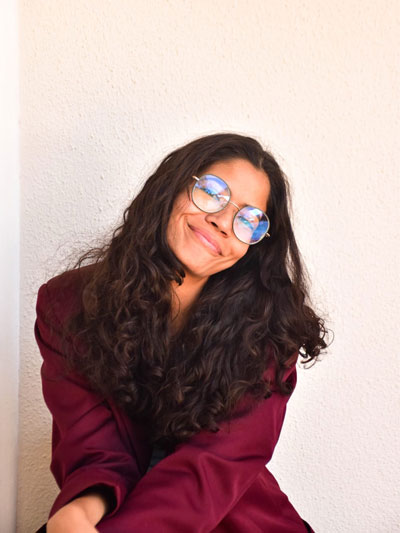
Biography
Lameez Hendricks is a first-year master’s student at Stellenbosch University. She completed her undergraduate degree on the dean’s list for academic achievement and completed her honour’s degree in 2024 cum laude. Lameez is a Golden Key recipient and works as a teaching assistant within the English Studies department at Stellenbosch University. Her focus areas, stemming from her honours research and current MA research, includes genocide and war studies, literary and cultural studies, trauma theory, and violence. Her MA thesis titled: “Gender and Victimhood in Joe Sacco’s Palestine (1993) and Footnotes in Gaza (2009)”, is the topic of her presentation today.
Paper Title
Gender and Victimhood in Joe Sacco’s Palestine (1993) and Footnotes in Gaza (2009)
Abstract
Palestine and Footnotes in Gaza are graphic novels written (and drawn) by Maltese American graphic journalist Joe Sacco. Both graphics explore historical events of the occupied Palestinian territories, providing both eye-witness testimony as well as first-hand survivor accounts of the Occupation. Through analysis of these texts, my thesis in its entirety explores the gendered representation of violence and is concerned with the gendered dynamics of victimhood in Sacco’s representations of violence in Occupied Palestine. Furthermore, it explores how the intersection of these two critical concepts – gender and victimhood – affects a reader’s view and understanding of violence and victimhood. A focus on this gendering of victimhood also guides us to think more critically of the question of perpetration in the context of Gaza. This conference presentation will focus on two aspects of gendered victimhood, namely: (1) the politics of naming in relation to female victims, as we see throughout the texts that only particular victims are referred to by their name, and (2) the erasure of male victimhood. In Frames of War, Judith Butler argues that contemporary global wars are grounded on powerful but fragile frames which see some lives as grievable and others as not. I therefore aim to interrogate these frames of depiction – focusing on “traditional” gender roles and through Sacco’s use of the graphic form. It is important to note that my research is entering an ongoing conversation, and that as a scholar within this field I remain cognizant of the fact that I bear witness to not only a historical trauma – but an ongoing one as well.
Yaadein Padiachy
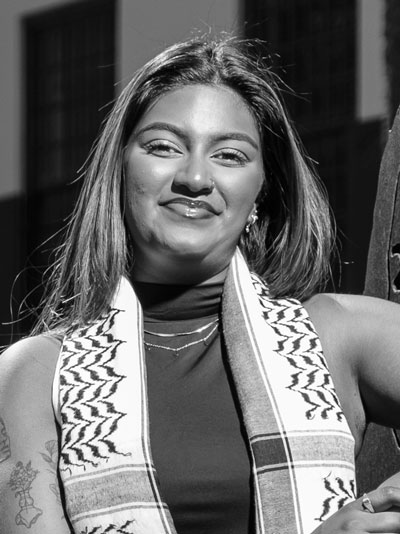
Biography
Yaadein Padiachy is a master’s candidate in Political Science at Stellenbosch University, where she also completed her undergraduate and honours degrees. As a research fellow at AVReQ, Yaadein focuses on human rights, the impact of coloniality in the global South, and the full liberation of oppressed peoples. Her commitment to activism serves as a driving force behind her research, motivating her to pursue scholarship that uplifts marginalized communities. Yaadein is particularly interested in work that contributes to academic discourse while promoting social justice by amplifying overlooked voices and advocating equity and dignity for all.
Paper Title
The Weight of a Word: Genocide, Crimes Against Humanity and the Politics of Classification
Abstract
This research will examine the cultural and political dynamics that shape how mass atrocities are classified in international law, focusing on the exclusion of “cultural genocide” from the legal definition set out in the UN Genocide Convention. Although Raphael Lemkin originally conceptualized genocide as encompassing both physical destruction and cultural erasure, the 1948 Convention reflects a narrower, politically motivated framing. This study will investigate how powerful states, particularly former colonial powers, influenced this exclusion to avoid scrutiny over their treatment of indigenous and minority populations.
Guided by the question of how cultural and political factors influence the classification of mass atrocities, the study will draw on constructivism, postcolonial theory, and critical discourse analysis to explore how identity, power, and discourse shape institutional responses. Methodologically, it will use comparative-historical analysis, applying descriptive inference and process tracing to four case studies: Gaza/Palestine, Nazi-occupied Europe, Armenia, and Guatemala (Maya).
By interrogating how identity functions in both the perpetration and recognition of genocide, and how classification is manipulated to serve political interests, the project will expose the limitations of current legal frameworks. The findings aim to contribute to scholarly debates on the politicization of genocide classification and advocate for a more inclusive and accountable international legal framework.
Ruth Linderoth
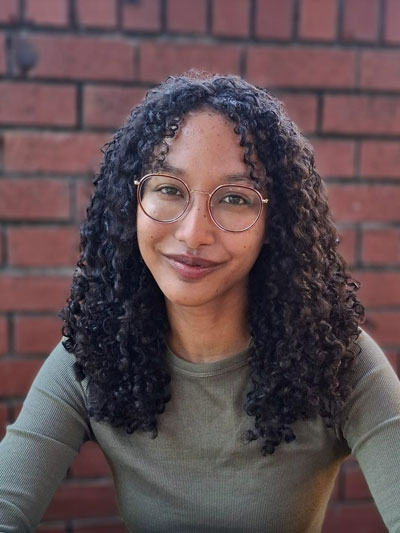
Biography
Ruth Linderoth is a Master’s Candidate in the philosophy department at the University of the Western Cape. Her research focus is on African ethics, applied ethics, metaphysics, and political philosophy. Her most recent research is on Just War Theory and its application to real cases of largescale violence in South Africa.
Paper Title
The Ethics of Large-Scale Violence in South Africa: Responding to Contemporary Just War Theory
Abstract
Considering the multifaceted consequences of large-scale violence, could there be any circumstances that would provide sufficient moral grounds for the initial resort to war? These kinds of questions have formed part of the broad basis of Just War Theory (JWT) in moral and political philosophy. However, while a considerable number of philosophers have attempted to tackle the question of when, if ever, war is morally permissible, there seems to be a gap in philosophical literature regarding the ethics of protest and intrastate-sanctioned violence, particularly in African philosophy. The first part of my project considers objections to the historical philosophical literature on Just War, as advocated for by Western philosophers such as Thomas Acquinas. In the crux of my project, I consider more contemporary theories of Just War by theorists such as, Jeff McMahan and Thaddeus Metz. I raise an objection of applicability to McMahan’s revisionist theory and similarly raise four problems for Metz’s theory in its application to a real-world case of intrastate-sanctioned violence in South Africa. My objections to Metz are centred on community, defensive force, noncombatant perspectives, and clarity on reconciliatory justice.
Alida Van Der Walt
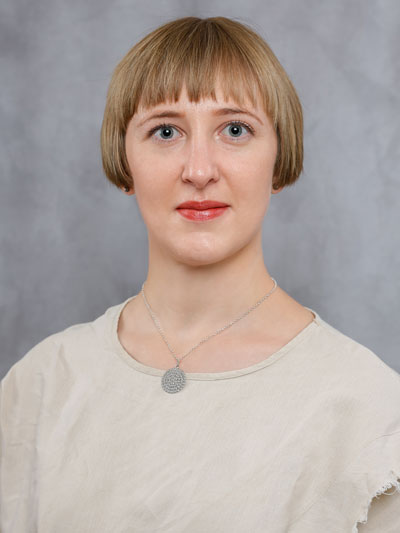
Biography
Alida van der Walt is currently pursuing doctoral studies as a fellow at the Centre for the Study of the Afterlife of Violence and the Reparative Quest (AVReQ) at Stellenbosch University under the supervision of Dr Carina Venter (Department of Music) and Dr Samantha van Schalwyk (AVReQ). Her research investigates the role that vocal/musical performance may play to bear witness to and, perhaps, compassionately apologise for sexual and gender-based violence in South Africa. She holds BMus and BMusHons degrees in vocal performance from the University of Stellenbosch and an MMus in Musicology from Rhodes University.
Paper Title
Bearing Witness to Sexual and Gender-Based Violence in South Africa Through Opera: Resonant Feminist Listening In/And/Through Four Recent Cape Town Opera Productions
Abstract
As a researcher, performer, and South African woman, I am compelled to explore the pervasive trauma of sexual and gender-based violence in our country and its entanglement with our colonial and apartheid histories. My doctoral research investigates how vocal performance may serve as a means of bearing witness to this trauma, and, critically, as a form of ethical apology for it. In the study as a whole, I explore the potential of opera and performance art to engage with the afterlife of historical violence/s and interrogate how the broader performing arts might contribute to reparative processes in this regard. For this paper, I will present a section of this research, namely, a close reading of four recent Cape Town Opera productions that engaged in some way with the theme of sexual and gender-based violence. Based on my preliminary analyses of interviews with some of the key creative driving forces (singers, directors) of those productions, I will explore how the production engaged, both explicitly and implicitly, with themes of sexual and gender-based violence in South Africa. Analyses will be supplemented with photo and video recordings of the production (where available), as well as data available in the public domain, like newspaper articles, reviews, and social media posts. Drawing on Helene Strauss’s framework of resonant feminist listening and Maria Cizmic’s theories of musical witnessing, I aim to engage with the colloquium’s focus on the continuities of violence and the transgenerational transmission of trauma, considering how embodied artistic practice can serve as a form of witnessing that opens space for dialogue, memory work, and healing.
Honest Hoeb
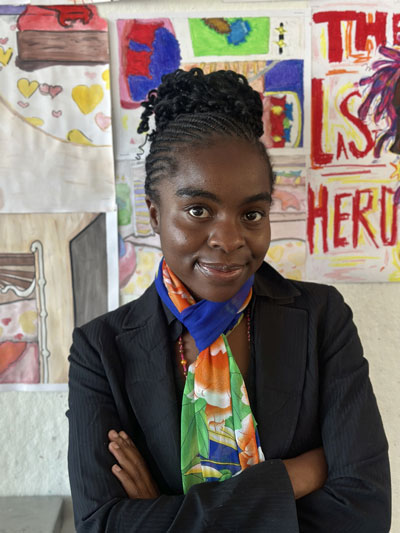
Biography
Honest Hoeb is a Namibian visual artist, poet, and secondary school teacher with the Ministry of Education, Arts and Culture. She holds an Honours degree in Secondary Education, specializing in Visual Art (Visual Culture) and English, and is currently pursuing a Master’s degree in Fine Arts Education at Stellenbosch University. A practicing visual artist, Honest primarily works with watercolour and lino-printing. Her creative and academic work is rooted in her cultural heritage and engages with themes of Namibian restitution, heritage preservation, and the decolonisation of education and museum practices. Passionate about intangible cultural heritage, she actively contributes to heritage, cultural, and tourism initiatives that seek to preserve and reimagine Namibia’s diverse traditions.
Paper Title
Echoes in the Land: Genocide, Apartheid, and the Ghostly Geographies of Postcolonial Namibia
Abstract
This paper explores how the landscapes of Namibia remain haunted by the unresolved traumas of both the German colonial genocide and South African apartheid. From the standpoint of a descendant of the Nama and Damara genocide, I reflect on how spatial divisions, dispossession, and symbolic erasures continue to shape contemporary Namibian society. Despite independence, justice was never fully served, and the country remains carved by racialised geographies where ghosts of the past still linger in the names of streets, the silence of unreturned ancestral lands, and the socioeconomic boundaries drawn through decades of colonial and apartheid rule.
I draw on concepts such as hauntology (Jacques Derrida), social haunting (Avery Gordon), and spatial justice (Edward Soja), while also centring the voices and lived realities of those whose stories have long remained beneath the surface. Through shared experiences, personal reflections, and everyday encounters with place, I explore how memory endures not only in monuments or archives, but also in our bodies, our families, and the spaces we are allowed or denied.
This paper is not only academic, it is emotional. It is an act of remembering. It is an attempt to give voice to the silences I have inherited and witnessed. I write from within the haunting, not outside of it, with the hope that speaking from this place can open a path toward deeper understanding, healing, and a more honest reckoning with the unfinished business of justice in Namibia.
Eva-Liisa Andima
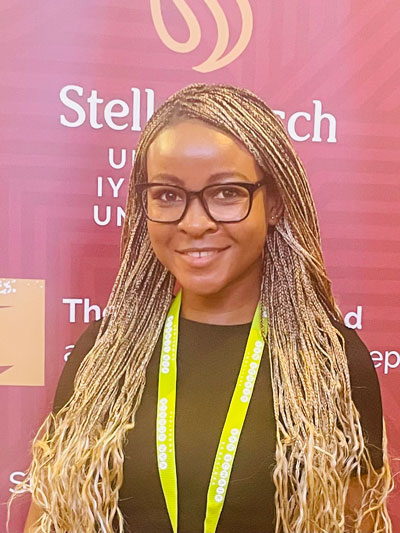
Biography
Eva-Liisa is a PhD candidate in English Studies, supported by the Andrew W. Mellon Foundation and the National Research Foundation through the SARChI Chair in Violent Histories and Transgenerational Trauma. She holds an MA in English Studies and a B.Ed. degree, both from the University of Namibia. Her research focuses on the intersection of gender, ecology, and colonial violence, examining how women, children and the environment are co-affected by historical violence.
Paper Title
When Everything Died: Gendered Violence and Muting in The Scattering
Abstract
coming soon.
Kanya Viljoen

Biography
Kanya Viljoen is a South African artist and scholar who works as a writer and director. She’s currently completing her PhD in English Philology and Cultural Studies at Heidelberg University as part of the Heidelberg Graduate School for the Humanities and Social Sciences (HGGS). She completed her MA Theatre and Performance (Cum Laude) at the University of Cape Town as an Andrew W Mellon scholar, and is a founding member of Unusual Bones, an interdisciplinary creative company working across film, theatre, and performance art. Her research explores decolonised and intersectional approaches to protests and acts of resistance. She has published in the South African Theatre Journal, Tydskrif vir Geesteswetenskappe and Gender Questions.
Paper Title
When ‘I’ Becomes ‘We’: Collective Resistance as Collective Reimagination
Abstract
In May 2015, the murder of 14-year-old Chiara Páez in Argentina ignited mass protests against gender-based violence, marking the birth of the #NiUnaMenos movement. That same year, footage of Arlette Contreras being brutally assaulted by her partner in Peru catalysed the largest demonstration in the country’s history. In 2019, the rape and murder of Uyinene Mrwetyana in South Africa ruptured public consciousness, triggering the #AmINext protests. These events, though rooted in specific geographies, exemplify how singular instances of violence transcend borders, transforming individual trauma into a shared political demand through collective resistance.
This paper examines how these protest movements function as speculative acts of world-building, where dystopian realities of systemic violence are confronted and reimagined through embodied resistance. By positioning protest as a performative act, I explore how the interplay between narrative and assembly blurs the boundaries between the personal and the collective, between visibility and invisibility, between mourning and mobilisation. These protests create a liminal pace—where identity is both asserted and dissolved, where singularity becomes multiplicity, and where individual grief is reshaped into communal action.
Drawing from performance studies by Butler (2015), Lehmann (2014) and cultural theory (Nünning, 2020), I analyse how resistance is enacted across multiple platforms—streets, digital spaces, and artistic interventions—demonstrating how movements like #NiUnaMenos and #AmINext operate as transmedial narratives. Chants, placards, viral hashtags, and public demonstrations transform personal testimony into collective mythmaking, challenging existing power structures while forging new imaginaries of justice. Through this lens, I argue that protests function as both a rupture and a reinvention: they expose dystopian conditions while simultaneously constructing speculative futures, where new possibilities for resistance and solidarity emerge.
By interrogating the performative and transmedial nature of these movements, this paper situates contemporary protest as a dynamic intersection of narrative, embodiment, and speculative reimagination—one where the act of assembly is not only an act of defiance, but a method of world-making.
Zihkona Plaaitjie & Nokuthaba Phakati
Biography
coming soon.
Paper Title
Ngubani Owasimamela?: Gender, Disability, and the Silence in SA Universities
Abstract
This co-authored paper explores how gender-based violence (GBV) is experienced and navigated by students who occupy multiple marginalised identities specifically female-identifying students and students with disabilities within South African higher education institutions. Despite the existence of institutional policies and support frameworks, GBV persists as a deeply embedded structural issue that disproportionately affects students whose bodies, identities, and experiences are already marginalised. Drawing on feminist intersectionality and feminist disability theory, this paper hopes to explore how violence may be enacted through institutional silencing, spatial exclusion, and inaccessible support systems.
Grounded in two Master’s-level qualitative research projects currently underway at the University of the Western Cape, the paper reflects on conceptual frameworks and preliminary insights. One study focuses on the lived experiences of female-identifying students through an intersectional feminist lens, while the other centres the perspectives of differently abled students, guided by the university’s Disability Unit and a feminist disability studies approach. Both studies adopt in-depth interviews and thematic analysis as key methods.
We argue that systemic violence in universities is not only interpersonal but also institutional shaped by race, gender, sexuality, disability, and socio-economic status. We highlight the need for intersectional, survivor-centred approaches to university policy and practice that can disrupt institutional harm and promote inclusive transformation. This presentation contributes to the growing call for decolonial, inclusive, and reparative strategies to address violence in higher education, proposing that amplifying marginalised student voices is not only an ethical imperative but a transformative step toward genuinely inclusive universities.
Zandile Dywati, Tema Maphosa, Bapiwe Gobodo, Siphosethu Baleni
Biography
Zandile Joy Dywati is a PhD candidate in the Psychology Department and a research fellow at the Center for the Study of the Afterlife of Violence and the Reparative Quest. Her worked in embodied through critical engagement with the question of race/ racialization/ and racism and its intersection to gendered subjectivities, particularly masculinities studies in Africa. She is interested in the existential question of blackness in township, which her PhD is centered on. A question that tarries on Biko’s philosophy of Black Consciousness Movement and his anguish against the death and loss of black manhood in Townships. In her work at the Children’s Institute implicated in the work of decolonizing childhood studies and particularly the Euro-Western narrativization on black and African childhoods. This quest is greatly emboldened on the work of Ndlovu-Gatsheni as a thinking departure point that shapes Zandile’s pursuit of epistemic disobedience. She is also a firm believer in the power of education in correcting some of the onto-epistemic challenges that plague blackness and Africanness.
Thabolwethu Tema Maphosa is uMuntu who is an Emerging Decolonial Scholar. He is a Research Assistant at the Stellenbosch Centre for Critical and Creative Thought, and MA Fellow at the Centre for the Study of the Afterlife of Violence and the Reparative Quest at the University of Stellenbosch. His scholarship seeks to engage and bear witness to Black life as it transpires on the margins. Beyond academic engagements, Thabolwethu is a creative writer, storyteller, spoken word poet (imbongi) and an archivist of mundane human experiences.
I am Bapiwe Gobodo a dedicated PhD candidate in Sociology at the University of Stellenbosch, my research focuses on the intricate and often racialised relationship between masculinity and violence. Exploring how masculine ideals shape and influence patterns of violence in the local context, my work seeks to contribute valuable insights to the broader discourse on gender, violence, and societal structures.
Ms Siphosethu Baleni is a master’s student in the Philosophy department at Stellenbosch University, supported by a scholarship from AVReQ, funded by First Rand Empowerment Foundation. She completed a BA in Philosophy and Psychology and an Honours in Philosophy at the University of Fort Hare. Her research interests include Critical Race thought, with a particular focus on Critical Existential Phenomenology.
Paper Title
Locating the ‘I’ in Researching Black Masculinities and Negotiating Gestures Towards Radical Imaginaries.
Abstract
We attempt to engage the juxtaposition of pathologizing constructions on black men and the need of new pathways that forge possibilities of humanizing the black masculine subject in post-Apartheid South Africa. Our conversation intends to firstly carve space on insisting the recollection of ‘self’ in doing research on the condition of blackness and black masculinity in Africa. In this regard, we posture the need to insist on critically engaging the ‘knower’ when doing work with, for and on African Masculinities. The location of the self not only sits through the framework of positionality but attempts to excavate from the damage-research paradigm ‘truths’ of black masculinities. Moreover, our conversation seeks to position the black masculine subject within conversations of colonial Apartheid trauma of geographies, aesthetics of memorialized black manhood posturing towards a ‘post’ patriarchal reading of black masculinities that postulates the commencing of humanizing work. In conclusion, we attempt to speak back to the failures of academic discourse in holding the tension and complexities of blackness, and African masculinities.