
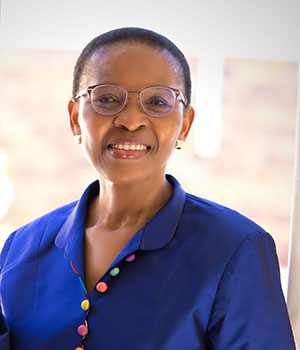
 Pumla Gobodo-Madikizela is Professor and Research Chair for Historical Trauma and Transformation, and the South African National Research Chair (SARChI) in Violent Histories and Transgenerational Trauma in the Faculty of Arts and Social Sciences. Her work is in the fields of trauma studies and research on the psychoanalytic interpretation of remorse and forgiveness. She was awarded a B-rating from the National Research Foundation, and she is a member of the Academy of Science of South Africa and an honorary member of the South African Psychoanalytic Association.
Her recent honours include The Harry Oppenheimer Fellowship Award, 2021; Harvard Radcliffe Institute Fellowship, 2020-2021; Honorary Doctor of Laws from Rhodes University (2019), and Honorary Doctor of Theology from the Friedrich-Schiller University, Jena, Germany (2017). Since 2017, she joined the faculty at Queen’s University, Belfast as Research Associate and Global Scholar affiliated with the Senator George Mitchell Institute for Global Peace, Security and Justice.
Click here for her Home Page and to view her full CV
E-mail: pumlagm@sun.ac.za | Tel: 021 808 4017
Current Research Project
My current project is in two phases. In Phase I, I return to the Truth and Reconciliation Commission (TRC) archive as a “research site” and engage a fine-grained analysis of a select group of TRC testimonies organised around specific moments of the TRC. A question that will provide structure and guide this process is how might the TRC process and South Africa’s transition from apartheid to democracy shed light on the problem of violence in contemporary South Africa? In Phase II of the project, I will build on my earlier work on remorse and forgiveness to explore what I have termed “reparative humanism.”
Recent Publications
Books
Gobodo-Madikizela, P., Ndushabandi, E., & Ratele, K. (Eds.) (2021). Historical trauma and memory: Living with the haunting power of the past. African Sun Media.
Gobodo-Madikizela, P. (Ed) (2020). History, trauma and shame: Engaging the past through second generation dialogue. London: Routledge.
Wale, K., Gobodo-Madikizela, P., & Prager, J. (2019). Post-conflict hauntings: Transforming collective memories of historical trauma. London: Palgrave MacMillan.
Gobodo-Madikizela, P., Bubenzer, F., & Oelofsen, M. (2019). These are the things that sit with us: Voices from Bonteheuwel, Langa, and Worcester. Cape Town: Jacana.
Book Chapters
Durbach, A., Bennett, J., & Gobodo-Madikizela, P. (2022). Designing reparations Creative process as reparative practice. The big anxiety: Taking care of mental health in times of crisis, (p. 153).
Gobodo-Madikizela, P. (2021). Remorse as ethical encounter and the impossibility of repair. In S. Tudor, R. Weisman, M. Proeve, & K. Rossmanith (Eds), Remorse and criminal justice: Multi-disciplinary perspectives. London: Routledge.
Gobodo-Madikizela, P. (2021). The limits of remorse: Internal and external dynamics. In Gobodo-Madikizela, P., Ndushabandi, E. & Ratele, K. (Eds.). Historical trauma and memory: Living with the haunting power of the past, (pp. 207-226).
Gobodo-Madikizela, P. (2020). Empathic repair in the aftermath of mass violence and trauma. In P. Gobodo-Madikizela, (Ed.), History, trauma and shame: Engaging the past through second generation dialogue, (pp. 19-37). London: Routledge.
Gobodo-Madikizela, P. (2019). Aesthetics of memory: Witness to violence and a call to repair. In K. Wale, P. Gobodo-Madikizela & J. Prager, Post-conflict hauntings: Transforming collective memories of historical trauma, (pp. 119-149). London: Palgrave MacMillan.
Gobodo-Madikizela, P. (2019). Moral imagination: Stories that inspire a quest for change. In J. Claasens (Ed.), Teaching for change: Essays on pedagogy, gender and theology in Africa. Stellenbosch: Sun Media.
Gobodo-Madikizela, P. (2018). Forgiveness is ‘the wrong word’: Empathic repair and the potential for human Connection in the aftermath of historical trauma. In M. Lerner & C. Schliesser (Eds.), Alternative approaches in conflict resolution: Rethinking peace and conflict studies (pp. 111-124). Palgrave Macmillan.
Journal Articles
Gobodo-Madikizela, P. (2023). The afterlife of apartheid: a triadic temporality of trauma. Social Dynamics, 49(1), 67-86. https://doi.org/10.1080/02533952.2023.2180215
Connolly, M., Gobodo-Madikizela, P., Layton, L., Nichols, B., Pivnick, B., & Reading, R. (2022). What’s repaired in reparations: A conversation among psychoanalytic and social activists. Psychoanalytic Dialogues, 32(1), 3-16.
Fourie, M.M., Stein, D.J., Solms, M., Gobodo-Madikizela, P., & Decety, J. (2019). Effects of early adversity and social discrimination on empathy for complex mental states: An fMRI investigation. Scientific Reports, 9(1), 1-14.
Githaiga, J. N., Gobodo-Madikizela, P., & Wahl, W. P. (2018). ‘They dug up wounds’: University of the Free State students’ experiences of transformation and integration in campus residences. Race Ethnicity and Education, 21(6), 773-790.